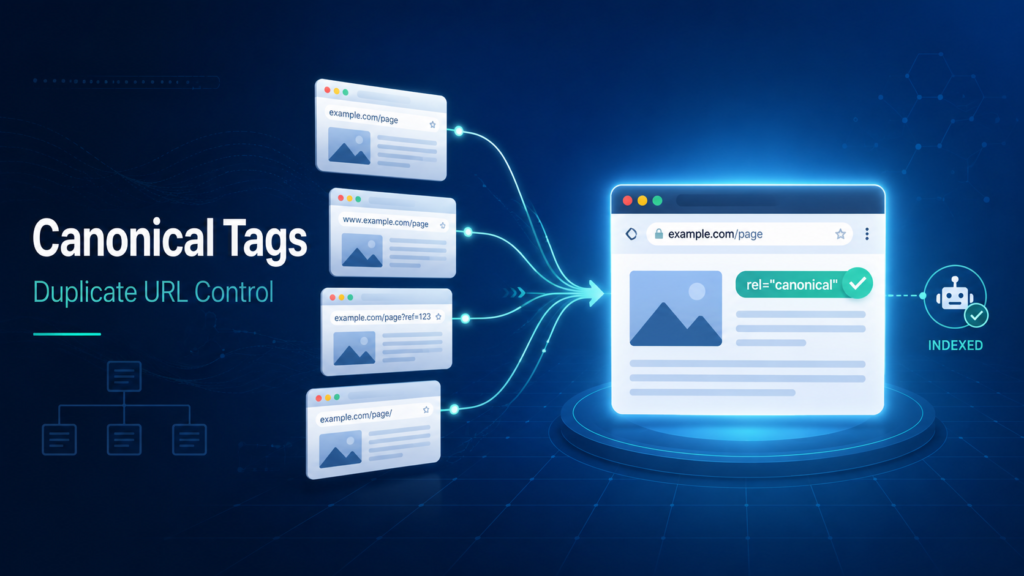
Canonical Tags and Duplicate URL Control System
Last reviewed: 2026-05-10. This EskiLab guide is written as a practical technical playbook, not a generic overview. It is designed to help teams build, test, fix, and monitor a working system around canonical tags duplicate URLs.
If your team is dealing with duplicate or near-duplicate URLs competing, wasting crawl attention, splitting signals, or showing the wrong URL in search, the expensive mistake is usually not the first error. The expensive mistake is having no repeatable process for diagnosis, testing, ownership, and monitoring. This guide gives you a system you can adapt before the problem becomes a production habit.
What this solves
This guide helps with duplicate or near-duplicate URLs competing, wasting crawl attention, splitting signals, or showing the wrong URL in search. It focuses on practical implementation decisions: what to define, what to log, what to test, what to avoid, and how to know whether the system is actually working after deployment.
Who this is for
This playbook is for technical SEO operators, WordPress site owners, Shopify teams, developers, and content managers dealing with categories, parameters, variants, and redirects. You do not need a large engineering team to use it, but you do need a clear owner, a testing habit, and a willingness to document decisions instead of leaving them inside one person’s head.
Short answer
A duplicate URL control system chooses the preferred URL, aligns canonical tags, internal links, redirects, sitemap URLs, and noindex rules, then validates Google’s selected canonical in Search Console.
When this problem usually happens
The issue usually appears when a workflow grows from a one-off setup into something the business depends on. A manual workaround may feel fine at low volume, but once traffic, records, events, or team members increase, undocumented assumptions become failure points.
Common triggers include platform updates, API version changes, new content batches, new product catalogs, automation retries, AI tool expansion, schema changes, or a new team member editing a workflow without knowing the original design assumptions.
Root causes and fast diagnosis
| Symptom | Likely cause | What to check first |
|---|---|---|
| Wrong URL appears in search | internal links and sitemap point to mixed URLs | Standardize preferred URLs across the site. |
| Duplicate product/category URLs | parameters, filters, or alternate paths | Use canonical, noindex, or blocking rules carefully. |
| Canonical ignored | signals conflict or page content differs too much | Align links, redirects, and content similarity. |
| Crawl waste | many low-value URL variations | Reduce unnecessary indexable parameter pages. |
Use this table as the first diagnostic layer. Do not jump directly to rewriting the whole system. In most cases, the fastest path is to isolate whether the failure comes from input data, configuration, permissions, transformation logic, timing, or monitoring gaps.
Step-by-step implementation system
- List duplicate URL patterns: trailing slash, parameters, collections, tags, filters, http/https, www/non-www, or variant paths.
- Choose the preferred canonical URL for each page group.
- Set self-referencing canonicals on clean indexable pages.
- Use canonical tags for true duplicate or very similar pages.
- Use redirects when a URL should no longer exist.
- Keep only canonical URLs in XML sitemaps.
- Point internal links to the preferred version.
- Validate Google-selected canonical in Search Console after changes.
The important part is not only completing the steps once. The goal is to make the system repeatable. A future teammate should be able to read the workflow, understand the expected input and output, run a safe test, and know when to escalate.
Example setup
A Shopify product may appear under multiple collection paths. The product page should have a consistent canonical strategy, internal links should avoid unnecessary alternate paths, and the sitemap should include the preferred product URL.
A good example setup has three layers: a safe test case, a production rule, and a monitoring rule. The test case proves the logic works. The production rule explains when it is allowed to run. The monitoring rule tells the team when the system has drifted away from expected behavior.
Common mistakes
- Using canonical tags as a replacement for redirects.
- Canonicalizing pages with substantially different content.
- Putting non-canonical URLs in sitemaps.
- Linking internally to parameter versions.
- Noindexing pages that still need signals consolidated.
- Assuming Google will always choose the declared canonical.
Risks and limitations
- Conflicting canonical, redirect, and sitemap signals can reduce clarity.
- Wrong canonical choices can hide useful pages.
- Faceted navigation changes can create thousands of thin URLs.
- Search Console may show a different selected canonical than the declared one.
- Large canonical changes should be rolled out carefully.
These risks do not mean the system should not be used. They mean the system needs boundaries. EskiLab’s standard is to define safe operating limits before scaling: what the workflow can do, what it cannot do, what requires review, and what should trigger an alert.
Testing checklist
Before treating this as production-ready, confirm the following:
- [ ] Preferred URL is defined for each duplicate group.
- [ ] Canonical tags match sitemap URLs.
- [ ] Internal links point to canonical versions.
- [ ] Redirects are used for retired URLs.
- [ ] Parameter pages are reviewed for index value.
- [ ] Search Console selected canonical is checked after deployment.
Recommended setup
For most small teams, the recommended setup is to start with a controlled version of canonical tags duplicate URLs, add validation before production actions, keep logs small but useful, monitor the system weekly, and update the playbook whenever a real failure teaches you something new.
Official documentation to check
Related systems
- Google Search Console Monitoring Workflow
- Shopify Collection SEO System
- Sitemap QA System for WordPress Imports
FAQ
Is canonical tags duplicate URLs a one-time setup?
No. Treat canonical tags duplicate URLs as an operating system that needs review after platform updates, traffic changes, schema changes, or workflow failures.
What should I test first?
Start with the smallest safe test case, confirm the expected output, then test edge cases, failures, duplicates, and permission boundaries.
Can this system guarantee results?
No. It can reduce risk and improve consistency, but technical systems still depend on data quality, implementation accuracy, monitoring, and maintenance.
Who should own the workflow?
Assign one operational owner for the workflow, one technical owner for implementation, and one reviewer for quality or business impact when the system affects customers, publishing, or revenue.
How often should this be reviewed?
Review high-impact workflows monthly and after every major CMS, API, theme, plugin, model, or platform change.