
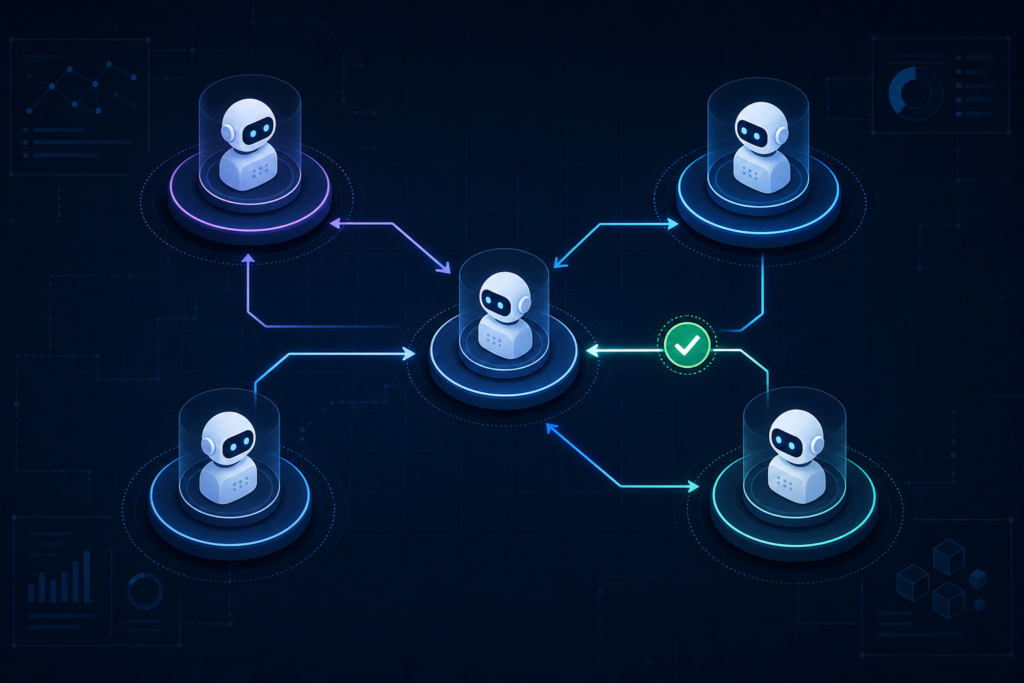
Most multi-agent failures don’t happen inside an individual agent’s reasoning — they happen at the handoff, the moment one agent passes control, context, or a partial result to another. A single agent with a bad prompt produces a bad output you can see immediately. A broken handoff produces a system that looks like it’s working right up until the final output is subtly, confidently wrong.
Why Handoffs Are the Actual Failure Point, Not the Agents Themselves
Teams building multi-agent systems tend to spend most of their debugging effort tuning individual agent prompts, when in practice the majority of production incidents trace back to what crosses the boundary between agents: incomplete context, silently dropped state, or an agent acting on a result it misinterpreted because the handoff didn’t specify a strict enough contract. A single well-tuned agent that receives garbage input from a handoff will still produce garbage output — no amount of prompt engineering on the receiving agent fixes a handoff problem upstream of it.
This matters more as systems scale past two agents. A two-agent handoff is easy to reason about manually. A five-agent pipeline with conditional branching creates handoff combinations that are effectively impossible to fully manually trace, which is exactly why handoff design needs to be treated as a first-class architectural concern, not an implementation detail left to whatever the orchestration framework does by default.
Three Handoff Patterns and When Each One Fits
| Pattern | How It Works | Best Fit | Main Risk |
|---|---|---|---|
| Sequential handoff | Agent A completes fully, passes a structured result to Agent B, which starts fresh | Linear pipelines (research → draft → review) | No shared context after handoff — B can’t ask A a follow-up |
| Shared-context handoff | Agents operate against a common, persistent context object or memory store rather than passing discrete messages | Collaborative tasks needing back-and-forth (multi-turn planning) | Context bloat and stale-state bugs if not pruned |
| Supervisor-routed handoff | A controlling agent decides which specialist agent to invoke next based on the current state | Systems with many possible specialist agents and unpredictable task paths | Supervisor becomes a single point of routing failure |
Most production systems end up using a mix — sequential handoffs within a fixed sub-pipeline, wrapped inside a supervisor-routed outer loop that decides which sub-pipeline to invoke. Picking one pattern for the whole system, rather than matching pattern to the actual shape of the task graph, is a common source of unnecessary complexity.
Designing the Handoff Contract
The single highest-leverage practice in multi-agent design is treating every handoff as an explicit contract — a defined schema for what crosses the boundary, not a free-form natural-language summary the next agent has to interpret. A handoff contract should specify:
- Required fields, not just useful ones. If the receiving agent cannot function without a specific piece of state, that field should be structurally required (schema validation failure, not a missing-context guess) rather than optional.
- Explicit completion status, not inferred from the presence of output. An agent that fails partway through should hand off a clear “incomplete” status rather than a plausible-looking partial result that the next agent treats as finished work.
- Provenance of the data — where did this claim, number, or decision come from. Without this, downstream agents (and human reviewers) can’t distinguish a verified fact from an earlier agent’s hallucination that’s now been passed along as established context.
- A version or step identifier, so that when something goes wrong three agents downstream, you can trace exactly which handoff introduced the problem instead of re-running the entire pipeline to reproduce it.
Handling Handoff Failure Without Silent Corruption
The most damaging failure mode in multi-agent systems isn’t a crash — it’s a malformed or incomplete handoff that the receiving agent accepts and works with anyway, because most agents are built to be helpful with whatever input they get rather than to reject bad input. Guard against this with validation at the boundary, not trust in the sender:
- Validate every incoming handoff against its schema before the receiving agent acts on it — reject and escalate rather than attempting to “figure out” a malformed payload.
- Build an explicit retry-or-escalate path for failed handoffs, distinct from the retry logic for a single agent’s own generation failures.
- Log the full handoff payload at every boundary, even in production — this is almost always the fastest way to diagnose which link in the chain introduced an error after the fact.