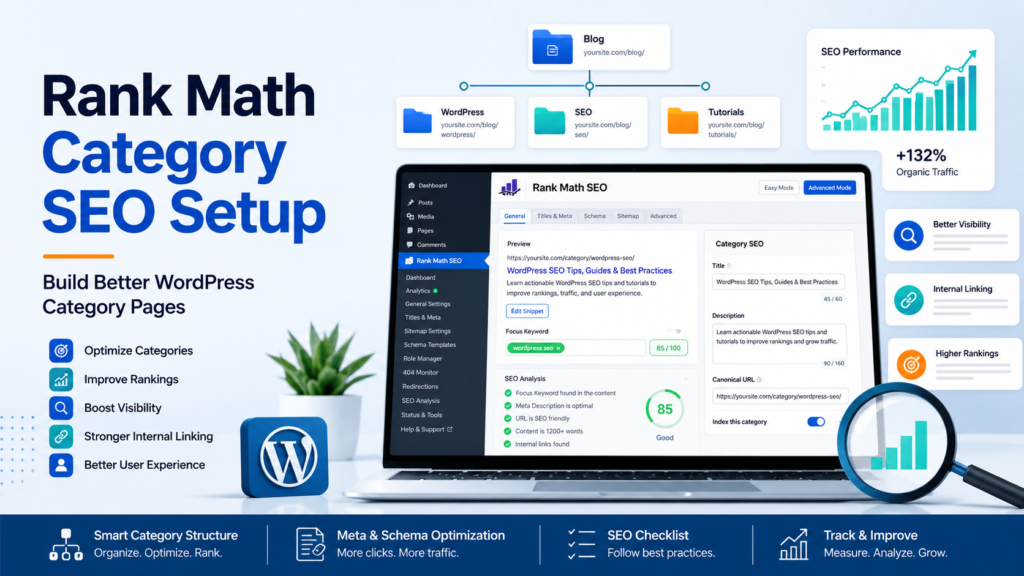
WordPress category pages can help users and search engines understand site structure, but only if they are useful. Empty archives with no explanation, no curation, and duplicate patterns often become weak pages.
What This Solves
This guide explains how to set up category SEO with clear category intent, useful intros, clean titles, descriptions, indexation decisions, and internal links.
Who This Is For
- Developers and technical operators
- SEO, automation, or e-commerce teams
- Site owners who need a repeatable workflow
- Editors or builders documenting technical systems
Short Answer
Keep only meaningful categories, write a unique category intro, add a clear SEO title and meta description, decide whether the category should be indexed, and link to the best guides.
When This Happens
Category SEO problems happen when a site creates too many categories, indexes empty archives, or uses categories as random labels instead of topic hubs.
Root Causes
| Symptom | Likely Cause | What to Check |
|---|---|---|
| Thin category page | No intro or curation | Category description |
| Categories overlap | Poor taxonomy | Category map |
| Generic title | Weak snippet | SEO title |
| Archive competes | Unclear indexation | Noindex vs index |
Step-by-Step Fix or Implementation
- Audit existing categories.
- Merge weak or overlapping categories.
- Define the purpose of each category.
- Write a helpful category description.
- Add a unique SEO title and meta description.
- Index only useful categories.
- Link best posts from the category page.
- Noindex thin tags or unused taxonomies.
Practical Example
| Field | Example | Reason |
|---|---|---|
| Category | SEO Systems | Clear topic |
| SEO title | SEO Systems: Practical Frameworks | EskiLab | Searchable |
| Meta description | Explore practical SEO systems for links, QA, schema, and refresh workflows. | Explains value |
| Indexation | Index if curated | Useful hub |
Common Mistakes
- Creating a category for every small topic.
- Indexing empty archives.
- Using generic tags as indexable pages.
- Leaving descriptions blank.
- Letting categories and hubs compete.
Risks and Limitations
- Changing categories can affect URLs if categories are in permalinks.
- Noindex decisions should be reviewed after cleanup.
- Rank Math behavior can vary by site configuration.
Security and Validation Notes
- Do not expose API keys, tokens, or private customer data in screenshots, frontend code, public logs, or repositories.
- Use least-privilege access and human approval for destructive actions.
- Test with safe sample data before connecting production systems.
- Monitor failures after deployment instead of assuming the first successful test is enough.
Testing Checklist
- [ ] Strong categories remain
- [ ] Each category has a purpose
- [ ] Intro written
- [ ] SEO title filled
- [ ] Meta description filled
- [ ] Index/noindex intentional
- [ ] Best posts linked
Recommended Setup
Keep a small category set, make each category page useful, and use Rank Math fields to create clear titles and descriptions instead of indexing empty archives.
Official Documentation to Check
Related Systems
- SEO QA Checklist Before Publishing a New Page
- Internal Linking System for WordPress Sites
- SEO Content Refresh System for Old Posts
FAQ
Should category pages be indexed?
Only if they are useful and curated.
Should tags be indexed?
Usually no, unless carefully curated.
Do Rank Math fields guarantee ranking?
No. They support metadata, but usefulness and structure matter.
Premium implementation notes
To make this guide production-ready, treat Rank Math Category SEO Setup as part of a larger WordPress taxonomy SEO governance system, not as a one-time fix. The practical goal is to create a repeatable process that another team member can follow without guessing. That means the article should define the owner, inputs, expected output, validation step, failure path, and maintenance schedule.
The most important risk to control is thin category archives, generic tags, duplicate taxonomy pages, and missing term metadata. A basic article might mention this risk once. A premium EskiLab article should show how the risk appears, how to test for it, what to log, and when to stop the workflow for manual review. This is what separates a surface-level tutorial from an operational playbook.
| Control area | Recommended setup | Why it matters |
|---|---|---|
| Owner | WordPress SEO owner | One person must be responsible for keeping the system accurate after publishing. |
| Primary risk | thin category archives, generic tags, duplicate taxonomy pages, and missing term metadata | The article should name the risk clearly instead of hiding it behind generic advice. |
| Validation action | write category intros, fill Rank Math term meta, consolidate categories, and noindex weak archives | The reader should know exactly what to verify before considering the setup complete. |
| Monitoring metric | indexed category quality and tag archive count | A premium guide should explain how to detect failure after the first setup. |
| Review cycle | Monthly or after major platform changes | Technical content can become stale when APIs, plugins, or platform rules change. |
Production runbook
Use this runbook whenever the system is created, edited, imported, or moved between staging and production. The runbook is intentionally simple because simple checks are easier to repeat consistently.
- Define the exact use case and the user problem this page or workflow solves.
- Assign the system owner: WordPress SEO owner.
- Complete the core validation action: write category intros, fill Rank Math term meta, consolidate categories, and noindex weak archives.
- Record the expected output and the conditions that should block publishing, retrying, indexing, or automation.
- Run at least one successful test and one controlled failure test before relying on the setup.
- Monitor the main health metric: indexed category quality and tag archive count.
- Schedule a review after major platform updates, plugin changes, API changes, site migrations, or bulk imports.
Validation scenarios
A premium technical guide should not only describe the final state; it should explain how to prove the system works. Use these validation scenarios before publishing the article or deploying the workflow described in it.
- Test the happy path where the WordPress taxonomy SEO governance system works with clean input and expected settings.
- Test the failure path where the most common risk appears: thin category archives, generic tags, duplicate taxonomy pages, and missing term metadata.
- Test a missing-data case so the workflow does not create an incomplete record or vague recommendation.
- Test a permission or access issue and confirm the system fails safely instead of exposing secrets or private data.
- Test the recovery path: what happens after the fix, retry, rollback, or manual review step?
Monitoring KPIs
After the first setup, the system should be monitored. Otherwise the same problem can return quietly after a deployment, plugin update, API change, content import, or data cleanup. Track a small number of useful signals instead of creating a dashboard nobody checks.
- Primary health metric: indexed category quality and tag archive count.
- Number of repeated failures or repeated manual fixes required.
- Number of pages, requests, workflows, or records affected by the issue.
- Time between problem detection and resolution.
- Whether the documented runbook was enough for another person to repeat the fix.
Editorial quality review
Before importing or scheduling this post, review it like a technical document. The page should help the reader build, fix, test, compare, automate, or monitor something. If it only defines a concept, it is not strong enough for EskiLab.
- The page has one clear search intent and does not try to cover unrelated problems.
- The article gives an answer early, then explains the system in enough depth for implementation.
- The content includes a table, checklist, example setup, risks, monitoring notes, and official documentation links.
- Claims are realistic. The page does not promise guaranteed rankings, revenue, security, or zero-error automation.
- Any AI-assisted or technical recommendation is framed as a workflow to validate, not as a magic shortcut.
Official documentation to check
Platform behavior can change. Before relying on this guide for a production workflow, verify current details with the relevant official documentation or primary reference below.

- Google Search Central: helpful, reliable, people-first content
- Google Search Central: spam policies
- Google Search Central: SEO Starter Guide
Premium FAQ additions
What makes this a premium EskiLab article?
It gives the reader a working system: diagnosis, implementation, validation, failure handling, monitoring, and maintenance. It does not stop at a definition or generic advice.
When should this guide be updated?
Update it after major API changes, plugin updates, Google Search documentation changes, AI model/tooling changes, Shopify changes, automation platform changes, or whenever a real failure reveals a missing step.
Should this workflow be automated fully?
Only low-risk repeatable steps should be automated without review. Any action that can publish, delete, charge, email, expose private data, or change customer records should include logging and human approval unless the team has a tested control system.