Most teams find out a competitor changed their pricing, shipped a feature, or started ranking for a new keyword cluster weeks after it happened — usually when a prospect mentions it on a sales call. A competitive intelligence monitoring system exists to close that gap: turning “we eventually noticed” into “we got an alert the week it happened,” without requiring someone to manually check ten competitor sites every Monday.
What’s Actually Worth Monitoring (and What’s Noise)
The failure mode most teams hit first isn’t under-monitoring, it’s over-monitoring — setting up alerts for every possible change until the volume of notifications means nobody reads any of them. A useful system starts narrow, tracking signals that actually change a decision when they fire:
| Signal | Why It Matters | Typical Check Frequency |
|---|---|---|
| Pricing page changes | Directly affects sales positioning and competitive messaging | Daily |
| New/changed SERP rankings for core keywords | Shows where a competitor is gaining or losing organic visibility | Weekly |
| New feature or product page launches | Early signal of roadmap direction and where they’re investing | Weekly |
| New backlinks from notable domains | Signals PR wins, partnerships, or content that’s earning links you might not have seen | Weekly to biweekly |
| Job postings (especially in specific departments) | Hiring surges in a department often precede a product or GTM shift by months | Biweekly |
| Messaging/positioning changes on the homepage | Reflects a shift in target audience or value proposition | Monthly |
Everything else — minor copy tweaks, blog publishing frequency, social media activity — is usually better handled with occasional manual review than a standing automated alert, since the signal-to-noise ratio is too low to justify interrupting anyone’s day.
Building the Monitoring Layer
A practical system has three layers, each answering a different question:
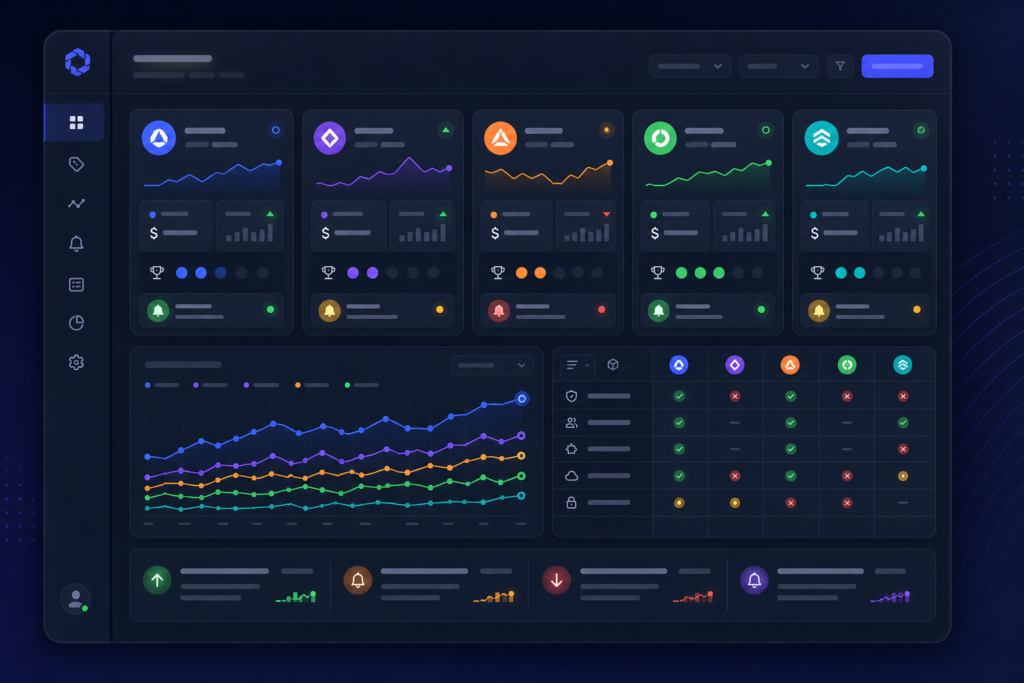
- Change detection. Automated page-diffing on a defined set of competitor URLs (pricing, key landing pages, homepage) catches changes as they happen rather than relying on someone remembering to check. This is the layer that turns “we noticed eventually” into “we got notified this week.”
- Rank and visibility tracking. Ongoing SERP position tracking for the keyword set that actually matters to your business — not every keyword a competitor ranks for, which produces the same noise problem as over-broad change detection.
- Structured logging, not just alerts. Every detected change should land in a shared log with a timestamp and screenshot/diff, not just a Slack notification that scrolls away. Six months from now, “when did they drop that pricing tier” is a question the log should answer in seconds, not require someone’s memory.
Turning Signals Into Decisions, Not Just Awareness
A monitoring system that only produces awareness — “FYI, Competitor X changed their pricing” — provides less value than one wired into an actual response process. The difference between a useful system and a noisy one is usually a lightweight triage step: someone (or an automated first-pass classifier) reviews each detected change and tags it by whether it requires action (update competitive battlecards, brief sales, adjust positioning) versus simply logging for the record. Without this step, competitive intelligence tends to become a channel people mute rather than a system that actually changes decisions.
Common Mistakes That Undermine These Systems
- Monitoring too many competitors at equal depth. A tiered approach — deep monitoring on 2–3 direct competitors, lighter monitoring on a broader watch-list — keeps the system sustainable as the competitive set grows.
- No owner for the alerts. If detected changes route to a channel nobody’s explicitly responsible for triaging, the system quietly stops being useful even while it keeps technically running.
- Treating rank-tracking data as precise rather than directional. SERP position data is noisy day-to-day due to personalization and testing — trend direction over weeks matters more than any single day’s snapshot, and systems that alert on every daily fluctuation train people to ignore the alerts entirely.
- No archive of historical changes. Without a searchable log, competitive intelligence work has to be redone every time someone asks “didn’t they used to have a different pricing structure?” instead of being answered from the record.