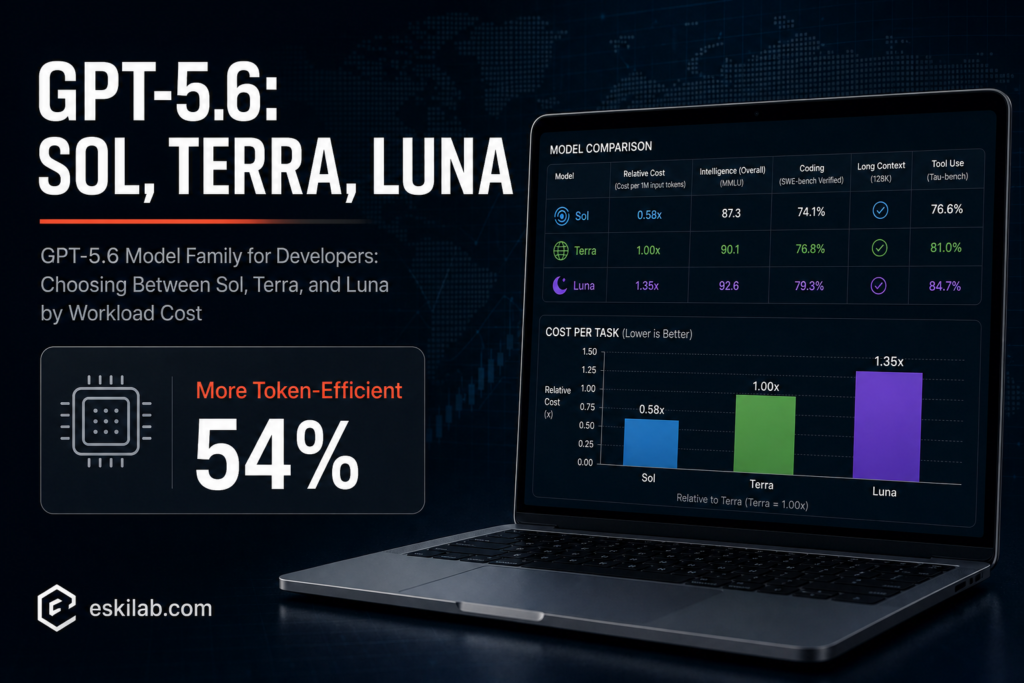
OpenAI opened GPT-5.6 to all users on July 9, 2026, rolling out across ChatGPT, Codex, and the API over 24 hours, and split the family into three variants — Sol, Terra, and Luna — instead of shipping one model and letting cost scale with usage volume alone. For a team already running production workloads on the 5.x line, this is a model-selection decision with real cost consequences, not just an upgrade to click through.
The Three Variants, by Job Fit
| Variant | Positioning | Fits Best For |
|---|---|---|
| Sol | Frontier capability, the workhorse of the family | Complex reasoning, coding tasks where correctness matters more than per-call cost, scientific or research workloads |
| Terra | Intermediate balance of intelligence and cost | Production features where quality matters but call volume makes Sol’s cost add up — a reasonable default for most product-facing agent workflows |
| Luna | Budget-friendly, high-volume | Classification, extraction, and other high-frequency, lower-complexity tasks where Sol-level reasoning is unnecessary overhead |
OpenAI’s own claim is that Sol is roughly 54% more token-efficient on coding tasks than the prior generation — worth verifying against your own workload rather than taking as a blanket multiplier, since efficiency gains on benchmark coding tasks don’t always transfer identically to your specific prompt patterns and tool-calling setup.
A Migration Approach That Doesn’t Just Swap the Model String
- Segment your current workload by actual complexity, not by which endpoint it happens to call today. A classification task running on an older frontier model purely out of inertia is a strong Luna candidate; a multi-step agent workflow doing real reasoning is not.
- Test Terra as the default before assuming you need Sol. Teams migrating tend to default to the top-tier variant out of caution, then discover months later that Terra handled the actual task correctly at a fraction of the cost — run the comparison before committing budget, not after.
- Re-run your existing eval set against all three variants instead of a handful of manual spot checks. A model swap that passes casual testing but fails on your evaluation set’s harder cases is a regression you want caught before production, not reported by users after.
- Watch tool-calling behavior specifically if your workflow relies on function calling or MCP tool use — model family changes sometimes shift how reliably a model formats tool call arguments, independent of general capability improvements.
- Roll out gradually with a fallback to your prior stable model version for a defined window instead of a hard cutover, so a subtle regression surfaces against a small percentage of traffic instead of all of it.
The Research-Access Angle, If It’s Relevant to You
OpenAI is also opening frontier access — including Sol Pro — to roughly 10,000 researchers this summer, with participating institutions already including places like the Institute for Advanced Study and École normale supérieure. If your organization has an academic or research affiliation, this is worth checking directly rather than assuming standard API pricing and access tiers are the only path in.