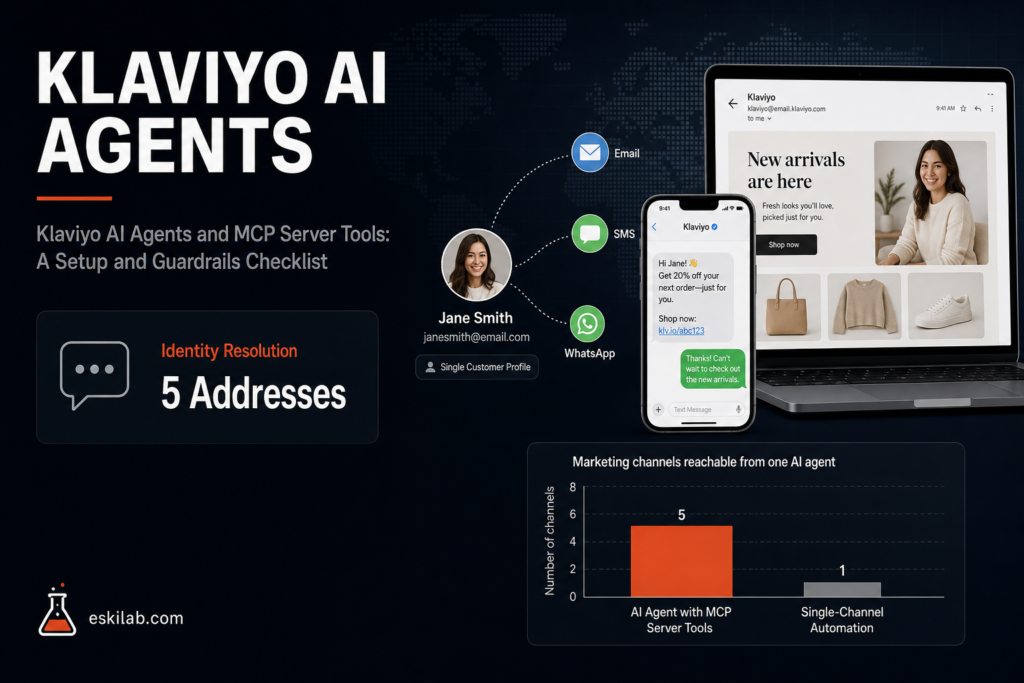
Klaviyo launched a beta for marketing AI agents on July 1, 2026 — configurable once, then able to act across email, SMS, WhatsApp, and web chat rather than being confined to a single channel’s automation flow. Combined with the MCP Server tools that now let external AI assistants like Claude or ChatGPT design email templates directly inside Klaviyo, this is a meaningfully bigger surface for something to go wrong autonomously than the flow-builder automations most e-commerce teams are used to auditing.
What’s New, Specifically
| Feature | What It Does | New Risk Surface |
|---|---|---|
| Multi-channel AI agents | Configured once, run across email, SMS, WhatsApp, and web chat | A single misconfigured agent now has reach across every channel a customer might receive a message on, not just one |
| MCP Server tools | External AI tools (Claude, ChatGPT) can design and edit email templates directly inside Klaviyo via MCP | Template edits made outside Klaviyo’s own UI may bypass whatever manual review step your team relies on for outgoing content |
| Composer | An always-on assistant that audits flows and campaigns and drafts messages grounded in account data | Drafts are grounded in real account data, which means a bad draft can include real customer specifics, not generic filler — reviewable, but only if someone actually reviews it |
| Identity resolution across up to five emails | Unified customer view with independent consent tracking per address | Consent state per address needs explicit verification — a unified profile view doesn’t remove the requirement to honor a specific address’s own opt-out |
A Guardrails Checklist Before Turning On Autonomous Sending
- Scope the agent’s channel permissions explicitly rather than granting all-channel access by default — an agent that only needs to handle post-purchase email follow-ups doesn’t need WhatsApp send permission.
- Require human approval on the first N sends for any new agent before letting it send autonomously, and keep that approval gate for any campaign type it hasn’t handled before, not just at initial setup.
- Audit MCP-originated template edits separately from edits made in Klaviyo’s own editor — if an external AI tool edited a template through the MCP Server connection, that edit should go through the same review step a human-made change would, not skip it because it came from a “trusted” integration.
- Verify consent is checked per address, not per customer profile, especially with the new five-address identity resolution — confirm a send respects the specific address’s opt-out status rather than assuming a unified profile view means unified consent.
- Set explicit escalation rules for what Composer or an agent should never do autonomously — refund offers, discount codes above a threshold, or anything touching a support complaint are reasonable candidates for a mandatory human handoff regardless of how confident the agent’s draft looks.
- Review agent-initiated sends on a recurring schedule, not just at launch — autonomous systems drift as product catalogs, promotions, and customer segments change, and a guardrail set that was sufficient at launch can become stale within a quarter.
Where This Still Needs a Human
Predictive analytics and content drafting are genuinely strong use cases for this kind of AI agent — the actual send decision for anything ambiguous, emotionally sensitive, or financially consequential (a refund, a complaint response, a price-sensitive offer) is not a good candidate for full autonomy yet, regardless of how well the tooling performs on routine flows. Build the guardrail list around what happens when the agent is wrong, not around how often it’s expected to be right.