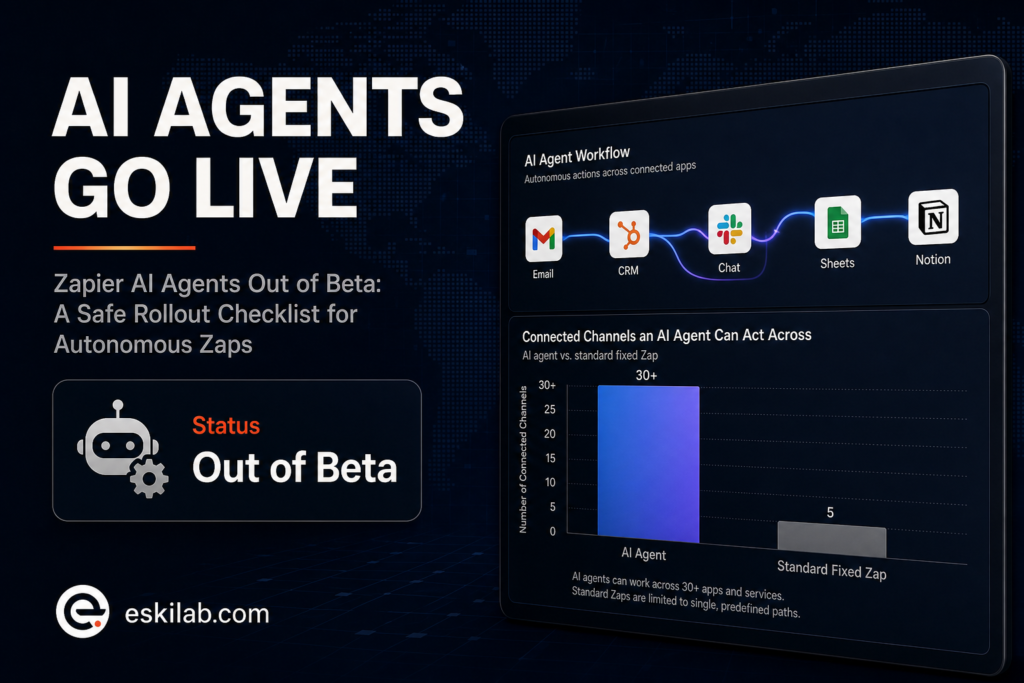
Zapier AI Agents are officially out of beta, and the underlying model is a real departure from what “a Zap” has meant for over a decade. A standard Zap follows a fixed trigger-to-action path you defined in advance. An agent plans its own steps toward a goal you describe in natural language, then executes across your connected app stack — which means the thing you’re reviewing before rollout isn’t a workflow diagram anymore, it’s a goal description and a set of permissions.
What’s Different From a Regular Zap
| Aspect | Standard Zap | Zapier AI Agent |
|---|---|---|
| Execution path | Fixed, defined step-by-step in advance | Planned by the model at run time toward a stated goal |
| What you review before launch | The exact trigger and every action step | The goal description, the tools/apps it’s allowed to touch, and the boundaries of acceptable actions — the actual steps aren’t fixed |
| Failure mode | A broken step fails visibly at that step | The agent can complete “successfully” while taking a plausible-but-wrong path toward the goal — a harder failure to catch by just checking whether it ran without error |
| Debugging | Look at the failed step’s input/output | Need visibility into the plan the agent chose, not just the final action’s result |
A Rollout Checklist
- Start with a narrow, low-stakes goal — something with a small, clearly bounded action space (draft a summary, tag a record) before trusting an agent with a goal that touches billing, customer communication, or data deletion.
- Scope app and action permissions explicitly, the same way you would for any integration with write access — an agent given broad access “in case it needs it” for a narrow task is a permissions mistake independent of how well the agent itself performs.
- Require a review step for the first batch of runs on any new agent, checking not just whether it reached the goal but which path it took to get there — a technically successful run that used an unexpected or risky method is worth catching before it becomes routine.
- Log the agent’s plan, not just its final actions, if Zapier’s tooling exposes that level of detail — debugging an agent that “did the wrong thing successfully” requires seeing what it decided to do and why, not just the end state.
- Set explicit stop conditions — actions the agent should never take autonomously regardless of how it interprets the goal (sending a payment, deleting a record, messaging a customer directly) — and verify those are enforced at the permission level, not just described in the prompt.
- Compare cost against a well-built standard Zap for goals with genuinely no ambiguity — a fixed trigger-to-action path is still simpler to audit, cheaper to run, and more predictable than an agent for a task that doesn’t actually need planning flexibility.
Where Agents Are a Clear Upgrade Over a Fixed Zap
Tasks where the right sequence of steps genuinely varies by input — triaging an incoming request that could route to three different systems depending on its content, for instance — are where an agent’s planning ability earns its complexity. Tasks with one obviously correct fixed path don’t need an agent’s flexibility, and adding it there just adds an unpredictable failure mode to something that worked fine as a deterministic Zap.