
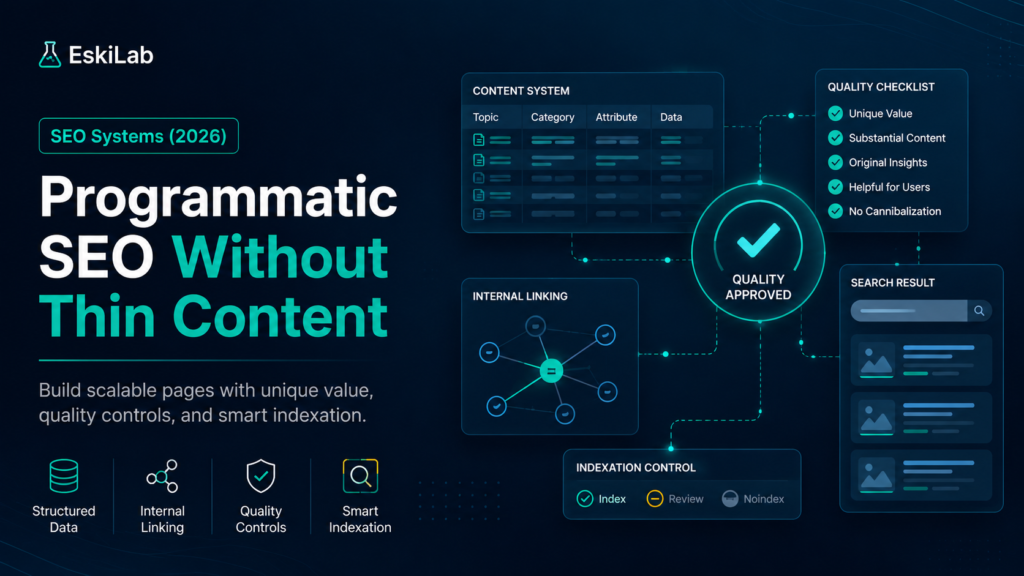
Programmatic SEO can work when each page solves a specific search intent with useful data, unique value, and quality controls. It fails when pages are created by swapping keywords into the same thin template.
What This Solves
This guide helps design a programmatic SEO system that uses data, templates, quality thresholds, indexation rules, and QA instead of mass-producing low-value pages.
Who This Is For
- Developers and technical operators
- SEO, automation, or e-commerce teams
- Site owners who need a repeatable workflow
- Editors or builders documenting technical systems
Short Answer
Start with a real dataset and a repeatable user need. Only index pages that have enough unique data, useful comparison, internal links, and editorial QA.
When This Happens
Thin programmatic pages happen when scale comes before usefulness: weak data, duplicate paragraphs, empty variables, low-quality templates, and no review process.
Root Causes
| Symptom | Likely Cause | What to Check |
|---|---|---|
| Pages look identical | No unique value | Data blocks |
| Indexed but no clicks | Weak intent | Query mapping |
| Many pages ignored | Quality threshold low | Index criteria |
| Pages compete | Cannibalization | Intent grouping |
Step-by-Step Fix or Implementation
- Define the exact user problem.
- Collect a trustworthy dataset.
- Create templates with unique value blocks.
- Set minimum data requirements.
- Noindex incomplete or low-value pages.
- Add internal links from hubs.
- Review a sample manually.
- Monitor indexing, clicks, duplicate titles, and cannibalization.
Practical Example
| Requirement | Pass | Fail |
|---|---|---|
| Unique data | Page-specific comparison table | Same intro with keyword swap |
| Intent | Specific query answered | No clear query |
| Indexation | Only complete pages index | All pages index by default |
| QA | Sample reviewed | No manual review |
Common Mistakes
- Generating pages before validating intent.
- Indexing every generated URL.
- Using fake uniqueness.
- Leaving empty variables visible.
- Skipping internal links.
- No refresh schedule.
Risks and Limitations
- Large-scale weak pages can create site quality problems.
- Generated pages can cannibalize each other.
- Manual QA is still needed before scale.
Security and Validation Notes
- Do not expose API keys, tokens, or private customer data in screenshots, frontend code, public logs, or repositories.
- Use least-privilege access and human approval for destructive actions.
- Test with safe sample data before connecting production systems.
- Monitor failures after deployment instead of assuming the first successful test is enough.
Testing Checklist
- [ ] Unique data exists
- [ ] Quality threshold defined
- [ ] Low-value pages noindexed
- [ ] Duplicate titles checked
- [ ] Internal links mapped
- [ ] Sample manually reviewed
- [ ] Search Console monitored
Recommended Setup
Start with a small pilot batch, strict indexation rules, useful data blocks, and manual QA. Scale only after the first batch proves useful.
Official Documentation to Check
Related Systems
- Internal Linking System for WordPress Sites
- SEO QA Checklist Before Publishing a New Page
- SEO Content Refresh System for Old Posts
FAQ
Is programmatic SEO bad?
No. The risk is low-value, duplicate, search-engine-first pages.
Should weak pages be noindexed?
Yes, if they do not provide enough unique value.
What makes a page useful?
Specific intent, unique data, clear explanation, and useful links.
Official documentation to check
Platform behavior can change. Before relying on this guide for a production workflow, verify current details with the relevant official documentation or primary reference below.