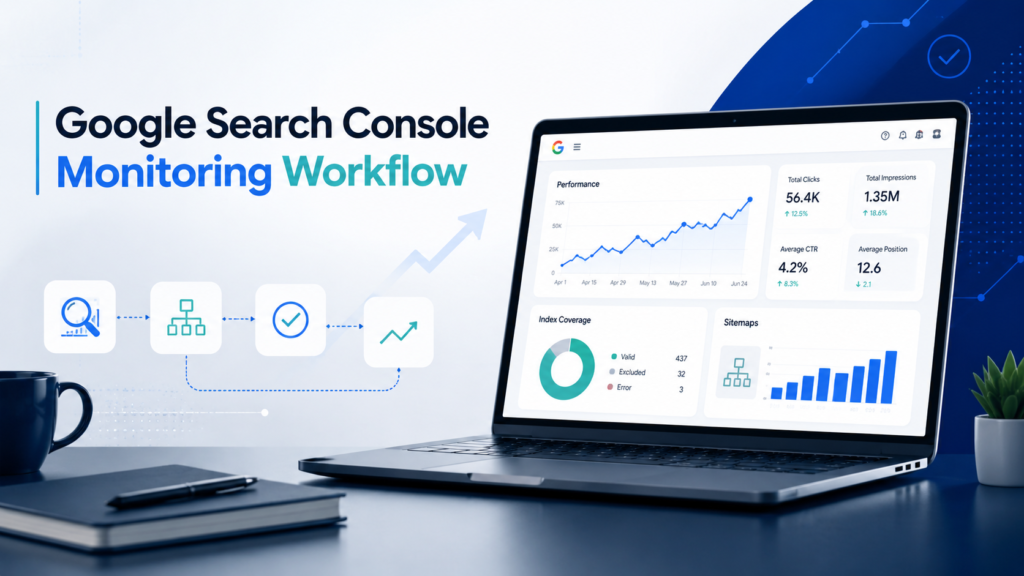
Google Search Console Monitoring Workflow
Last reviewed: 2026-05-10. This EskiLab guide is written as a practical technical playbook, not a generic overview. It is designed to help teams build, test, fix, and monitor a working system around Google Search Console monitoring.
If your team is dealing with SEO issues staying unnoticed until traffic drops because Search Console data is not reviewed with a repeatable workflow, the expensive mistake is usually not the first error. The expensive mistake is having no repeatable process for diagnosis, testing, ownership, and monitoring. This guide gives you a system you can adapt before the problem becomes a production habit.
What this solves
This guide helps with SEO issues staying unnoticed until traffic drops because Search Console data is not reviewed with a repeatable workflow. It focuses on practical implementation decisions: what to define, what to log, what to test, what to avoid, and how to know whether the system is actually working after deployment.
Who this is for
This playbook is for SEO operators, site owners, content teams, developers, and marketing managers responsible for organic search performance. You do not need a large engineering team to use it, but you do need a clear owner, a testing habit, and a willingness to document decisions instead of leaving them inside one person’s head.
Short answer
A Search Console monitoring workflow reviews performance, indexing, sitemaps, page experience, enhancement issues, query shifts, and changed pages on a weekly schedule with clear action ownership.
When this problem usually happens
The issue usually appears when a workflow grows from a one-off setup into something the business depends on. A manual workaround may feel fine at low volume, but once traffic, records, events, or team members increase, undocumented assumptions become failure points.
Common triggers include platform updates, API version changes, new content batches, new product catalogs, automation retries, AI tool expansion, schema changes, or a new team member editing a workflow without knowing the original design assumptions.
Root causes and fast diagnosis
| Symptom | Likely cause | What to check first |
|---|---|---|
| Traffic drops unnoticed | no weekly performance review | Monitor clicks, impressions, CTR, and position by page group. |
| Pages not indexed | coverage and inspection checks are ignored | Review indexing reasons and sitemap inclusion. |
| Sitemap errors persist | sitemap report is not monitored | Check submitted sitemaps after publishing batches. |
| SEO actions cannot be measured | no change log | Record title, content, redirect, and internal link changes. |
Use this table as the first diagnostic layer. Do not jump directly to rewriting the whole system. In most cases, the fastest path is to isolate whether the failure comes from input data, configuration, permissions, transformation logic, timing, or monitoring gaps.
Step-by-step implementation system
- Create page groups by category, template, or business priority.
- Review Search performance weekly for clicks, impressions, CTR, and average position.
- Check queries that gained or lost impressions for each important page.
- Review indexing status for newly published or refreshed pages.
- Check sitemap processing after large imports or CMS changes.
- Review enhancement and structured data reports for new errors.
- Maintain an SEO change log with date, URL, change type, and expected outcome.
- Set a monthly review for cannibalization, decay, and content refresh candidates.
The important part is not only completing the steps once. The goal is to make the system repeatable. A future teammate should be able to read the workflow, understand the expected input and output, run a safe test, and know when to escalate.
Example setup
After importing 15 scheduled EskiLab posts, a monitoring workflow should confirm sitemap discovery, indexing status, internal links, query impressions, and any structured data warnings before judging traffic performance.
A good example setup has three layers: a safe test case, a production rule, and a monitoring rule. The test case proves the logic works. The production rule explains when it is allowed to run. The monitoring rule tells the team when the system has drifted away from expected behavior.
Common mistakes
- Looking only at total site clicks.
- Ignoring impressions because clicks are low.
- Checking new pages too soon and making random changes.
- Not separating brand and non-brand queries.
- Forgetting to document SEO edits.
- Treating average position as exact rank tracking.
Risks and limitations
- Search Console data has delays and sampling limitations.
- New pages may take time to discover and rank.
- Changing too many variables at once makes analysis unclear.
- Low-volume pages need longer measurement windows.
- Indexing is not guaranteed even when technical setup is correct.
These risks do not mean the system should not be used. They mean the system needs boundaries. EskiLab’s standard is to define safe operating limits before scaling: what the workflow can do, what it cannot do, what requires review, and what should trigger an alert.
Testing checklist
Before treating this as production-ready, confirm the following:
- [ ] Weekly performance review is scheduled.
- [ ] Priority page groups are defined.
- [ ] Sitemap status is checked after content imports.
- [ ] Indexing status is reviewed for new pages.
- [ ] SEO change log is maintained.
- [ ] Monthly refresh candidates are selected from data.
Recommended setup
For most small teams, the recommended setup is to start with a controlled version of Google Search Console monitoring, add validation before production actions, keep logs small but useful, monitor the system weekly, and update the playbook whenever a real failure teaches you something new.
Official documentation to check
Related systems
- Content Refresh System for Old SEO Posts
- Schema Markup System for WordPress Sites
- Sitemap QA System for WordPress Imports
FAQ
Is Google Search Console monitoring a one-time setup?
No. Treat Google Search Console monitoring as an operating system that needs review after platform updates, traffic changes, schema changes, or workflow failures.
What should I test first?
Start with the smallest safe test case, confirm the expected output, then test edge cases, failures, duplicates, and permission boundaries.
Can this system guarantee results?
No. It can reduce risk and improve consistency, but technical systems still depend on data quality, implementation accuracy, monitoring, and maintenance.
Who should own the workflow?
Assign one operational owner for the workflow, one technical owner for implementation, and one reviewer for quality or business impact when the system affects customers, publishing, or revenue.
How often should this be reviewed?
Review high-impact workflows monthly and after every major CMS, API, theme, plugin, model, or platform change.