
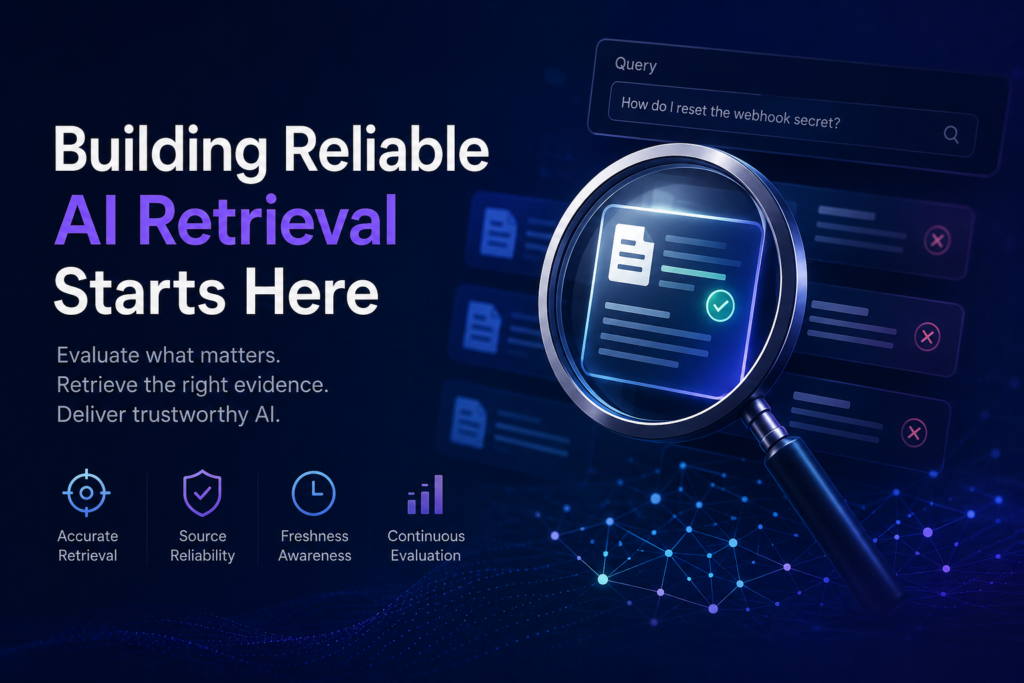
AI Retrieval Evaluation Test Set for RAG Quality
Last reviewed: 2026-05-10. This is a deep EskiLab implementation guide for AI retrieval evaluation test set. It is written for teams that need operational reliability, not a surface-level definition.
RAG quality starts before the answer. If retrieval returns the wrong evidence, a polished answer is just a confident failure.
What this guide is designed to do
This guide helps teams measure whether a RAG system finds the right evidence before judging whether the final answer sounds good. It focuses on the operating decisions behind the system: ownership, data contracts, failure modes, QA scenarios, monitoring, and the point where automation should stop and review should begin.
Who should use this
Ai builders, documentation teams, support teams, product operators, and agencies maintaining retrieval-based ai assistants should use this as a production planning and QA reference. It is especially relevant when the workflow affects customers, analytics, public pages, revenue, product data, or long-running automation.
Executive summary
A reliable AI retrieval evaluation test set system defines the operating contract, validates inputs before action, tests failure modes, monitors drift after launch, and documents ownership so the workflow can be maintained without guesswork.
Evaluate retrieval separately from generation
A RAG answer can be fluent, helpful-sounding, and wrong because the evidence was wrong. Separate the retrieval test from the answer test. First ask: did the system find the correct source? Only then ask whether the model used that source well.
Your evaluation set should include questions with expected source labels. The label can be a specific document, a group of approved documents, or a source type. Without source labels, the team ends up judging vibes instead of retrieval quality.
Hard negatives and source conflicts
Hard negatives are questions where a similar but wrong document is likely to be retrieved. For example, an old policy page, a discontinued product manual, or a similar API endpoint. These are more valuable than easy questions because they reveal whether retrieval can distinguish close matches.
Add source conflict cases where two documents disagree. The expected behavior might be to prefer the newest source, the official policy, or a page with higher authority metadata. Write that priority rule into the evaluation notes.
Freshness-sensitive queries
Some answers depend on current documentation, pricing, API versions, inventory, or policy. Include freshness-sensitive questions that should fail if the system retrieves stale content. Track stale-source rate separately from irrelevant-source rate.
Evaluation set fields
| Field | Purpose | Example |
|---|---|---|
| query | Real user wording | How do I reset the webhook secret? |
| expected_source | Correct evidence | Webhook security guide |
| hard_negative | Likely wrong source | Old webhook setup draft |
| freshness_required | Shows time sensitivity | yes |
| failure_label | Classifies issue | stale source, wrong product, no source |
Retrieval metrics
| Metric | What it tells you | Action if weak |
|---|---|---|
| Top-1 source match | Best result correctness | Improve metadata and chunk titles |
| Top-5 source match | Whether evidence is available | Tune ranking or chunking |
| Stale source rate | Freshness failure | Update source lifecycle |
| No-source rate | Coverage gap | Add or improve docs |
| Hard-negative failure | Confusion between similar docs | Add disambiguating metadata |
Implementation workflow
- Collect real questions from support tickets, site search, chat logs, sales calls, or internal users.
- Label the expected source for each question.
- Add hard negatives that are similar but wrong.
- Add freshness-sensitive questions.
- Add ambiguity cases that should ask for clarification.
- Run retrieval tests without generating final answers.
- Track source match metrics by query type.
- Review failures and fix chunking, metadata, source priority, or document quality.
Common mistakes that make this system shallow
- Testing only easy internal questions.
- Judging the final answer without checking retrieved evidence.
- Using only clean technical wording instead of real user language.
- Not testing stale or conflicting documents.
- Changing the test set whenever results look bad.
- Treating one demo success as production readiness.
Pre-production QA checklist
- [ ] Each query has expected source labels.
- [ ] Hard negatives are included.
- [ ] Freshness-sensitive cases are included.
- [ ] Ambiguity cases are included.
- [ ] Retrieval is measured before generation.
- [ ] Failures are categorized and reviewed.
Monitoring signals after launch
Do not judge the system only by whether the first test worked. Use ongoing monitoring to detect drift, silent failure, and operational risk.
- top-1 source match
- top-5 source match
- stale-source rate
- hard-negative failure rate
- no-answer rate
Incident review questions
- What exact input, event, URL, record, prompt, or action triggered the failure?
- Was the failure caused by source data, mapping, permissions, timing, platform behavior, or missing validation?
- Did the system fail safely, or did it create a downstream side effect?
- Was the issue visible in logs or only discovered by a user?
- What rule, test case, monitor, or approval step should be added so this failure is easier to catch next time?
Official documentation to check
Recommended operating standard
For AI retrieval evaluation test set, the minimum operating standard is: define the contract, test the failure modes, monitor the output, document the owner, and keep a rollback or review path. Anything less may work in a demo but will be fragile in production.
FAQ
Why is AI retrieval evaluation test set not just a one-time setup?
Because the surrounding systems change: APIs, tools, data, user behavior, plugins, prompts, feeds, and business rules. A one-time setup without monitoring becomes stale.
What is the first thing to test?
Test the failure mode that would create the most business damage: duplicate writes, wrong public pages, bad tracking, invalid feed data, unsafe AI action, or broken indexation.
Should this be automated completely?
Only low-risk, reversible steps should be fully automated. Anything that changes customer data, sends messages, publishes pages, affects payments, or modifies important SEO signals should have review, logging, or staged rollout.
How do I know the article's system is deep enough to publish?
It should include a real operating model: data fields or rules, failure modes, QA scenarios, monitoring signals, mistakes, and official documentation references.