Disclosure: EskiLab is reader-supported. Some links below may be affiliate links. We only list tools we consider credible for the use case, and an affiliate relationship does not change a tool’s placement or assessment. Pricing and features change often—verify current details on the vendor’s site before buying.
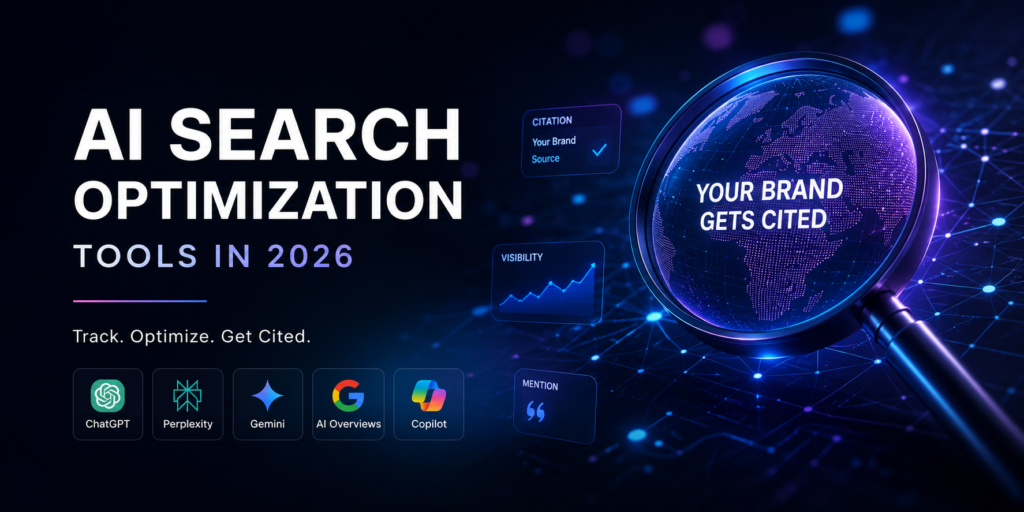
A growing share of searches now end inside an AI answer instead of a list of blue links. Generative Engine Optimization (GEO) and Answer Engine Optimization (AEO) tools exist to track whether your brand gets cited in ChatGPT, Perplexity, Gemini, Google AI Overviews, and Copilot—and to show why. This is one of the few SEO areas where a newer site can move quickly, because the playing field is young. This guide compares the categories of tools, names representative platforms, and gives a decision framework.
Short answer: GEO/AEO tools fall into two buckets: visibility trackers (do AI engines cite you, for which prompts) and optimization workflows (what to change to get cited). Profound and Peec AI sit at the tracking-and-analytics end; HubSpot’s free AEO Grader and Geoptie are good low-cost starting points. Start by measuring before you pay for execution.
Who this is for
- SEO and content teams seeing organic clicks flatten while AI answers rise
- Brand and PR owners who want to know how AI engines describe them
- Founders deciding whether GEO deserves budget yet
- WordPress site owners (Rank Math users) wanting to add schema and structure for AI citation
How we compared these tools
AI search tooling is noisy and many vendors rebranded overnight. We judged platforms on:
- Engine coverage (ChatGPT, Perplexity, Gemini, AI Overviews, Copilot, Claude, Grok)
- Whether it tracks citations and sources, not just whether your name appears
- Prompt volume and how representative the tracked prompts are of real queries
- Whether it stops at monitoring or also guides what to change
- Pricing honesty—several tools gate the useful engines behind higher tiers
Quick comparison
| Tool | Type | Notable strength | Starting point |
|---|---|---|---|
| HubSpot AEO Grader | Free audit | Quick brand score across dimensions | First check, no cost |
| Geoptie | Freemium | Free GEO audit + content checker | Hands-on testing |
| Peec AI | Tracking | Multi-engine visibility & competitors | Ongoing monitoring |
| Profound | Analytics | Citation analysis at scale | Teams investing in GEO |
| Semrush / Ahrefs AI add-ons | Suite add-on | AI tracking beside normal SEO | Existing suite users |
Treat the table as a starting filter, not a verdict. The right pick depends on your stack, budget, and how much you want to maintain.
The tool types, and when each one fits
Free graders and audits (HubSpot AEO Grader, Geoptie free tier)
Before paying for anything, run a free grader to see whether AI engines currently mention you and how. These give a baseline brand score and surface obvious structure gaps. For a young site, this is often enough to start acting.
Best when: you are measuring for the first time and want a no-cost baseline. Watch out for: free tools sample a limited set of prompts and engines; treat the score as directional.
Visibility trackers (Peec AI and similar)
These run a set of prompts on a schedule across multiple AI engines and report where you appear, your position in the answer, sentiment, and which sources got cited. The value is the citation and source data—knowing who is being cited for your target prompts tells you what to publish.
Best when: you want ongoing monitoring and competitor benchmarking. Watch out for: useful engines are often gated to higher tiers; confirm coverage before subscribing.
Citation analytics platforms (Profound and similar)
At the higher end, these analyze citations at scale and map the source hierarchy behind AI answers and AI Overviews. They are built for teams treating GEO as a real channel with budget and a content engine behind it.
Best when: GEO is a funded channel and you publish enough to act on the data. Watch out for: overkill for a site still building its first dozen articles.
SEO suite AI add-ons (Semrush, Ahrefs)
If you already pay for a suite, its AI-tracking add-on lets you watch AI visibility next to normal rankings without a new login. Convenient, though depth of AI-specific data varies.
Best when: you already run the suite and want one dashboard. Watch out for: add-on history and engine depth can be thinner than dedicated GEO tools.
How to choose: a simple decision framework
- Run a free AEO grader to get a baseline—do AI engines cite you at all?
- Test your top 10 real queries manually in ChatGPT, Perplexity, and Gemini and record who gets cited.
- Fix structure first: clear headings, FAQ and Article schema (Rank Math makes this easy), and citable, specific claims.
- Only buy a tracker once you have content worth monitoring and competitors to benchmark.
- Re-test the same prompts monthly; GEO moves faster than classic SEO.
Common mistakes
- Paying for a tracker before you have content worth tracking
- Optimizing for mentions while ignoring whether the AI describes you accurately
- Assuming GEO replaces SEO—the underlying signals (structure, authority, schema) overlap heavily
- Tracking vanity prompts no real user types
- Ignoring that engines update constantly, so a one-time audit goes stale
Risks and limitations
- AI engines change ranking behavior without notice; gains can disappear
- Citation data is sampled and approximate, not a guaranteed measure
- Chasing AI visibility can pull effort away from content that actually converts
- Some tools report “mentions” that are negative or inaccurate—read the context
- Pricing tiers often hide the engines you care about behind upgrades
Selection checklist
- [ ] I ran a free grader and recorded a baseline
- [ ] I manually tested my top real queries across engines
- [ ] My pages have clear structure and valid schema
- [ ] I confirmed which engines a paid tool actually covers
- [ ] I track prompts real users would type, not vanity ones
- [ ] I set a monthly re-test date
Recommended setup
Start free: run HubSpot’s AEO Grader, then manually test your ten most important queries in ChatGPT, Perplexity, and Gemini and note who gets cited. Use Rank Math to add FAQ and Article schema and tighten page structure. Only subscribe to a tracker like Peec AI once you have a body of content worth monitoring and a competitor set to benchmark against. For a young site, the structure work matters more than the tooling.
Related guides
FAQ
What is the difference between GEO, AEO, and SEO?
SEO optimizes for ranking in traditional results. GEO (generative engine optimization) optimizes for being surfaced inside generative AI platforms. AEO (answer engine optimization) is the broader umbrella covering any direct-answer surface, including AI Overviews and featured snippets. In practice the underlying work—clear structure, authority, schema—overlaps heavily.
Can a small or new site win at AI search?
It can compete faster than in classic SEO because the space is young and rewards clear, specific, well-structured content. Small sites can implement structural changes quickly, though authority signals still matter.
Do I need a paid GEO tool to start?
No. Free graders plus manual testing in the major engines give you a usable baseline. Pay for tracking once you have content and competitors worth monitoring.
How do I actually get cited in AI answers?
Answer specific questions directly, use clear headings and FAQ/Article schema, make claims concrete and citable, and build genuine authority. Then test your target prompts and iterate.