
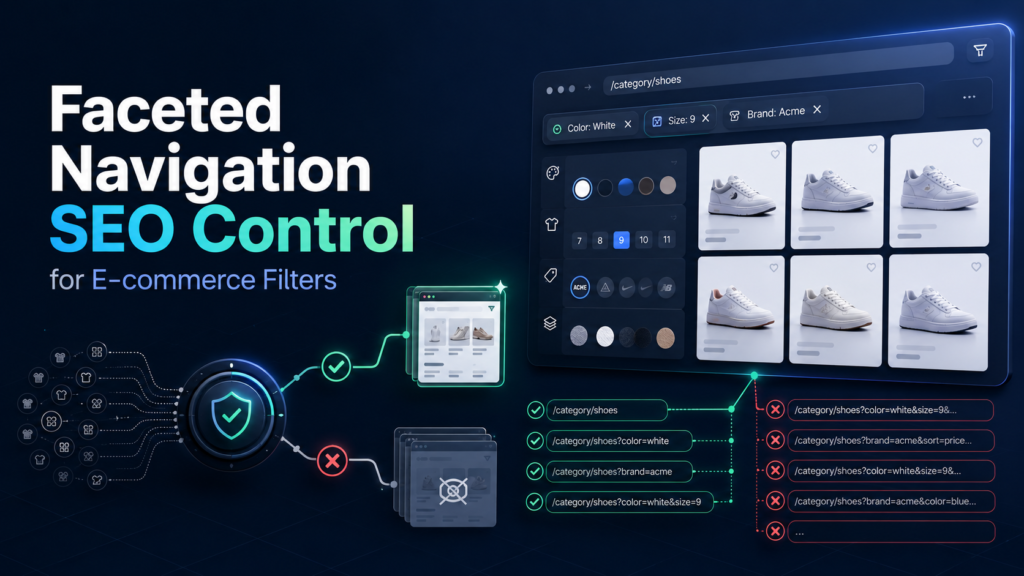
Faceted Navigation SEO Control for E-commerce Filters
Last reviewed: 2026-05-10. This is a deep EskiLab implementation guide for faceted navigation SEO. It is written for teams that need operational reliability, not a surface-level definition.
Facets are useful for shoppers but dangerous for search when every combination becomes a crawlable page.
What this guide is designed to do
This guide helps teams decide which filter URLs should be indexable, which should be controlled, and which deserve curated landing pages. It focuses on the operating decisions behind the system: ownership, data contracts, failure modes, QA scenarios, monitoring, and the point where automation should stop and review should begin.
Who should use this
E-commerce operators, shopify teams, technical seos, developers, and merchandisers managing category filters should use this as a production planning and QA reference. It is especially relevant when the workflow affects customers, analytics, public pages, revenue, product data, or long-running automation.
Executive summary
A reliable faceted navigation SEO system defines the operating contract, validates inputs before action, tests failure modes, monitors drift after launch, and documents ownership so the workflow can be maintained without guesswork.
The filter value test
Do not start by asking whether a URL has a parameter. Ask whether the filtered result has unique search demand, stable inventory, clear user value, and enough difference from the parent category. If yes, it may deserve a curated landing page. If not, it should usually remain a user interface path, not a search landing page.
Good index candidates often combine product type and meaningful attribute: 'grey sectional sofas', 'queen storage beds', or 'waterproof vinyl flooring'. Poor candidates are usually sort orders, temporary prices, empty filters, or arbitrary combinations.
Curated pages beat raw parameter pages
If a filtered intent is valuable, create a controlled page with unique title, intro copy, internal links, merchandising logic, and canonical URL. Raw parameter URLs often lack the content quality needed to stand alone in search.
Curated pages also give teams control over internal linking and sitemap inclusion. That control is better than hoping Google interprets an infinite filter system correctly.
Inventory stability matters
A filtered page that has 30 products today and 0 next month is risky. Before indexing a facet, review whether inventory is stable enough to satisfy searchers. Low inventory can turn a once-useful page into thin content.
Facet decision matrix
| Facet type | SEO value | Recommended handling |
|---|---|---|
| Brand | Often high | Curate if demand and inventory exist |
| Color/material | Medium to high | Curate selectively |
| Price sort | Low | Keep non-indexable |
| Availability | Low alone | Usually non-indexable |
| Size | Depends on category | Curate if search demand exists |
| Multiple arbitrary filters | Usually low | Control crawl/indexation |
Search landing page threshold
| Requirement | Why it matters | Minimum standard |
|---|---|---|
| Demand | Prevents thin pages | Evidence from keyword/search data |
| Inventory | Satisfies users | Enough stable products |
| Unique content | Avoids duplicate category copy | Specific intro and metadata |
| Internal links | Supports discovery | Linked from relevant hubs |
| Sitemap inclusion | Clarifies canonical URL | Only curated URLs included |
Implementation workflow
- Inventory all filters and URL parameter patterns.
- Score each facet by search demand, user value, inventory stability, and uniqueness.
- Create curated landing pages for high-value filtered intents.
- Canonicalize or noindex low-value filter combinations where appropriate.
- Prevent sort and tracking parameters from becoming indexable landing pages.
- Keep sitemaps focused on canonical categories and curated pages.
- Monitor crawl behavior and indexation after changes.
- Review inventory-driven pages periodically.
Common mistakes that make this system shallow
- Letting every filter combination index.
- Blocking all filters without preserving valuable intents.
- Putting parameter URLs in sitemaps.
- Using identical copy on every filtered page.
- Indexing pages with unstable or tiny inventory.
- Not monitoring crawl waste after launch.
Pre-production QA checklist
- [ ] Facet inventory exists.
- [ ] Indexable facet rules are documented.
- [ ] Curated pages exist for valuable intents.
- [ ] Low-value parameters are controlled.
- [ ] Sitemaps exclude crawl traps.
- [ ] Inventory stability is reviewed.
Monitoring signals after launch
Do not judge the system only by whether the first test worked. Use ongoing monitoring to detect drift, silent failure, and operational risk.
- indexed parameter URL count
- crawl hits on filter URLs
- curated page impressions
- thin filtered page count
- inventory count by indexed facet
Incident review questions
- What exact input, event, URL, record, prompt, or action triggered the failure?
- Was the failure caused by source data, mapping, permissions, timing, platform behavior, or missing validation?
- Did the system fail safely, or did it create a downstream side effect?
- Was the issue visible in logs or only discovered by a user?
- What rule, test case, monitor, or approval step should be added so this failure is easier to catch next time?
Official documentation to check
Recommended operating standard
For faceted navigation SEO, the minimum operating standard is: define the contract, test the failure modes, monitor the output, document the owner, and keep a rollback or review path. Anything less may work in a demo but will be fragile in production.
FAQ
Why is faceted navigation SEO not just a one-time setup?
Because the surrounding systems change: APIs, tools, data, user behavior, plugins, prompts, feeds, and business rules. A one-time setup without monitoring becomes stale.
What is the first thing to test?
Test the failure mode that would create the most business damage: duplicate writes, wrong public pages, bad tracking, invalid feed data, unsafe AI action, or broken indexation.
Should this be automated completely?
Only low-risk, reversible steps should be fully automated. Anything that changes customer data, sends messages, publishes pages, affects payments, or modifies important SEO signals should have review, logging, or staged rollout.
How do I know the article's system is deep enough to publish?
It should include a real operating model: data fields or rules, failure modes, QA scenarios, monitoring signals, mistakes, and official documentation references.