
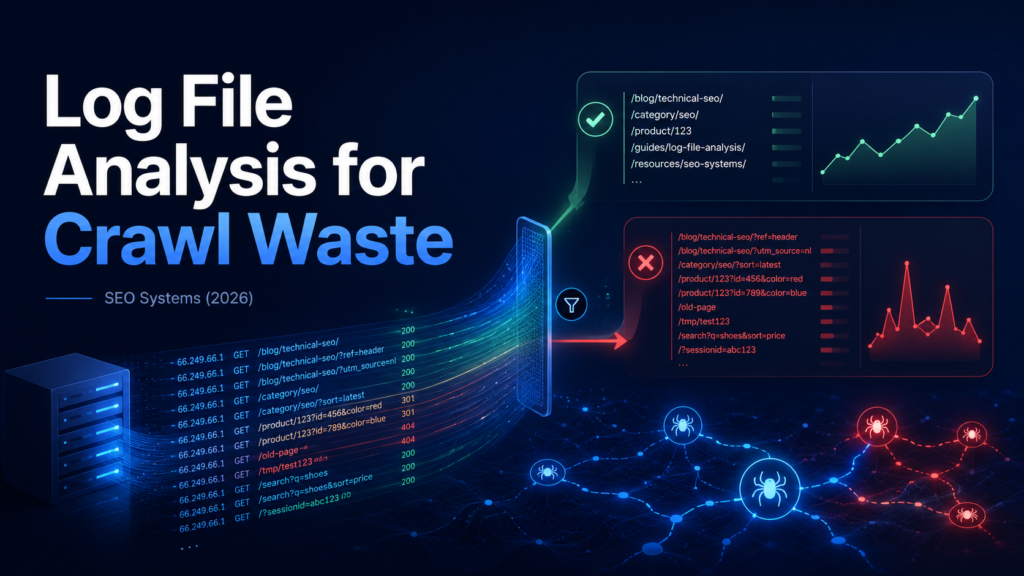
Log File Analysis Workflow for Crawl Waste
Last reviewed: 2026-05-10. This is a deep EskiLab implementation guide for log file analysis for crawl waste. It is written for teams that need operational reliability, not a surface-level definition.
Crawl tools show what could be crawled. Server logs show what bots actually requested.
What this guide is designed to do
This guide helps teams understand what search bots actually crawl and reduce crawl attention spent on low-value, duplicate, broken, or redirected URLs. It focuses on the operating decisions behind the system: ownership, data contracts, failure modes, QA scenarios, monitoring, and the point where automation should stop and review should begin.
Who should use this
Technical seos, developers, publishers, e-commerce operators, and site owners managing large url sets should use this as a production planning and QA reference. It is especially relevant when the workflow affects customers, analytics, public pages, revenue, product data, or long-running automation.
Executive summary
A reliable log file analysis for crawl waste system defines the operating contract, validates inputs before action, tests failure modes, monitors drift after launch, and documents ownership so the workflow can be maintained without guesswork.
Why logs reveal a different truth
A sitemap tells you what you submitted. A crawler tells you what it discovered from a crawl starting point. Server logs tell you what actually hit the server. For crawl waste analysis, that difference matters. Search bots may spend time on parameters, redirects, old URLs, feed URLs, attachment pages, or pagination paths you forgot existed.
Log analysis is most useful when grouped by URL template. Individual URL review does not scale. Group requests into product pages, category pages, tag archives, parameters, redirects, 404s, media files, search pages, and API paths.
Bot verification and data hygiene
Do not blindly trust user-agent strings. Some bots spoof Googlebot or other crawlers. Where possible, use verified logs, reverse DNS validation, or infrastructure tooling that identifies legitimate bots. At minimum, separate known search bots from unknown crawlers and internal monitoring tools.
Logs can contain sensitive URLs or query strings. Treat exports carefully, remove unnecessary personal data, and avoid uploading raw logs into tools that are not approved for that data.
Crawl value scoring
Not every crawled URL is bad. Score URL groups by crawl volume, index value, business value, status code, internal link source, and duplication risk. A high-crawl high-value product template may be healthy. A high-crawl low-value parameter template is a waste candidate.
Crawl waste patterns
| Pattern | What it means | Possible fix |
|---|---|---|
| High 301 volume | Bots follow old links or chains | Update internal links and clean redirects |
| High 404 volume | Old URLs still discovered | Redirect useful matches or remove links |
| Parameter crawl spike | Filters/tracking URLs discoverable | Control facets and canonical strategy |
| Low priority pages crawled often | Architecture dilutes crawl attention | Improve internal linking |
| Important pages rarely crawled | Weak discovery or low authority | Strengthen links and sitemap |
URL group review
| URL group | Keep crawl? | Reason |
|---|---|---|
| Canonical products | Yes | Revenue pages |
| Empty tag archives | No | Thin archive risk |
| Sort parameters | Usually no | Duplicate ordering only |
| Filtered high-demand category | Maybe | Can be curated |
| Redirect chains | No | Waste and latency |
Implementation workflow
- Collect at least two to four weeks of server logs if available.
- Filter by verified or trusted search bot traffic.
- Normalize URLs by removing noise and grouping templates.
- Summarize requests by status code and URL group.
- Identify high-crawl low-value groups.
- Compare crawl activity with sitemap, internal links, and Search Console data.
- Fix internal links, redirects, canonicals, parameter rules, or noindex strategy.
- Collect follow-up logs after changes to confirm behavior shifts.
Common mistakes that make this system shallow
- Using crawler output instead of server logs.
- Trusting every Googlebot user agent.
- Looking only at total bot hits.
- Blocking URLs before understanding why they are crawled.
- Not grouping URL templates.
- Making robots.txt changes without testing side effects.
Pre-production QA checklist
- [ ] Logs cover enough time.
- [ ] Bot filtering is documented.
- [ ] URL templates are grouped.
- [ ] Status code patterns are summarized.
- [ ] High-crawl low-value groups are identified.
- [ ] Follow-up logs are reviewed after fixes.
Monitoring signals after launch
Do not judge the system only by whether the first test worked. Use ongoing monitoring to detect drift, silent failure, and operational risk.
- crawl hits by URL group
- 404 bot hits
- 301/302 bot hits
- parameter crawl count
- priority page crawl frequency
Incident review questions
- What exact input, event, URL, record, prompt, or action triggered the failure?
- Was the failure caused by source data, mapping, permissions, timing, platform behavior, or missing validation?
- Did the system fail safely, or did it create a downstream side effect?
- Was the issue visible in logs or only discovered by a user?
- What rule, test case, monitor, or approval step should be added so this failure is easier to catch next time?
Official documentation to check
Recommended operating standard
For log file analysis for crawl waste, the minimum operating standard is: define the contract, test the failure modes, monitor the output, document the owner, and keep a rollback or review path. Anything less may work in a demo but will be fragile in production.
FAQ
Why is log file analysis for crawl waste not just a one-time setup?
Because the surrounding systems change: APIs, tools, data, user behavior, plugins, prompts, feeds, and business rules. A one-time setup without monitoring becomes stale.
What is the first thing to test?
Test the failure mode that would create the most business damage: duplicate writes, wrong public pages, bad tracking, invalid feed data, unsafe AI action, or broken indexation.
Should this be automated completely?
Only low-risk, reversible steps should be fully automated. Anything that changes customer data, sends messages, publishes pages, affects payments, or modifies important SEO signals should have review, logging, or staged rollout.
How do I know the article's system is deep enough to publish?
It should include a real operating model: data fields or rules, failure modes, QA scenarios, monitoring signals, mistakes, and official documentation references.