Disclosure: EskiLab is reader-supported. Some links below may be affiliate links. We only list tools we consider credible for the use case, and an affiliate relationship does not change a tool’s placement or assessment. Pricing and features change often—verify current details on the vendor’s site before buying.
In 2026, open-weight LLMs are no longer experiments—they run inside real engineering pipelines, and the gap with closed frontier models on everyday agentic work has narrowed to single-digit percentages while costing far less. If you are building agents and want privacy, cost control, or no per-token bill, this guide compares the leading open models by the factors that decide deployment: agentic reliability, license, context length, and hardware. Note that this frontier moves monthly, so re-check before you commit.
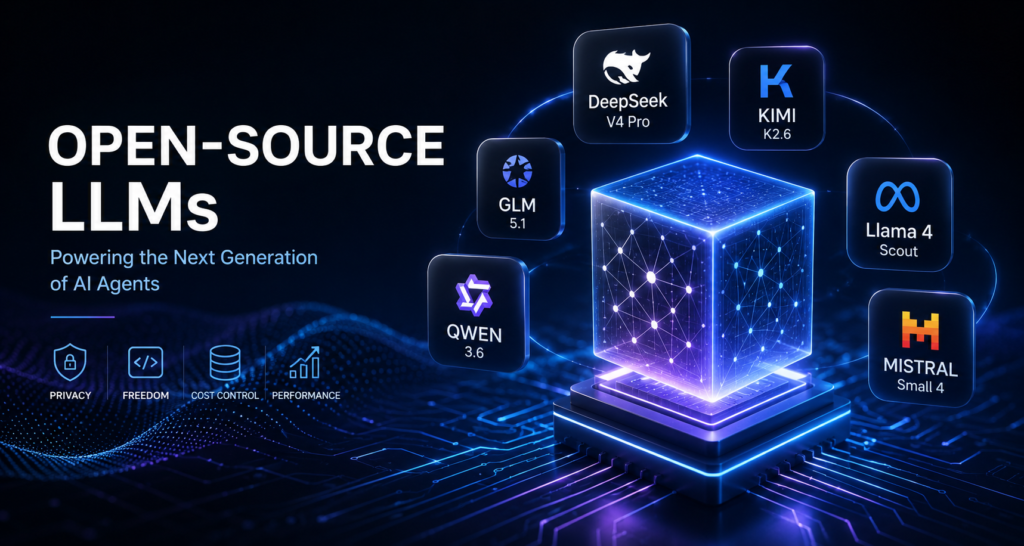
Short answer: For agentic coding, DeepSeek V4 Pro and Kimi K2.6 are at the top of the open-weight tier, with GLM-5.1 close behind. Qwen 3.6 (especially the smaller dense variants under Apache-2.0) is the best practical local choice. Llama 4 Scout leads on ultra-long context; Mistral Small 4 suits strict Apache-2.0 needs. Pick by workload, license, and hardware.
Who this is for
- Developers building agents who want open weights for privacy or cost
- Teams in regulated settings that need on-prem or private deployment
- Technical founders avoiding per-token API bills at scale
- Anyone choosing a model to self-host with Ollama, vLLM, or SGLang
How we compared these tools
Benchmarks shift monthly, so weight durable deployment factors alongside scores:
- Agentic reliability: multi-step task completion and tool-call accuracy
- License safety (Apache-2.0 and MIT are the most permissive)
- Context length for long-running or long-context agent tasks
- Hardware requirements and serving stack fit
- Performance-to-cost ratio for self-hosted inference
Quick comparison
| Model | Strongest at | License | Note |
|---|---|---|---|
| DeepSeek V4 Pro | Agentic coding | MIT | Top agentic tier; serious hardware |
| Kimi K2.6 | Coding / agentic | Open | Leads several neutral indexes |
| GLM-5.1 | Long-horizon agent tasks | MIT | Clean license, strong agentic |
| Qwen 3.6 (27B/35B-A3B) | Practical local agents | Apache-2.0 | Best small dense coder |
| Llama 4 Scout | Ultra-long context | Llama license | 10M-token context; MAU cap |
| Mistral Small 4 | Fine-tuning, EU deploys | Apache-2.0 | Smaller, fast to fine-tune |
Treat the table as a starting filter, not a verdict. The right pick depends on your stack, budget, and how much you want to maintain.
The models, and when each one fits
DeepSeek V4 Pro and Kimi K2.6 (top agentic tier)
These sit at the top of open-weight agentic performance in 2026, competitive with closed frontier models on multi-step coding and tool use. DeepSeek V4 ships with large context and MIT licensing; Kimi K2.6 leads several neutral indexes. Both target serious agent workloads and need real GPU hardware.
Best when: you need frontier-class agentic ability and have enterprise GPUs. Watch out for: hardware demands are high; these are not laptop models.
GLM-5.1 (clean license, long-horizon tasks)
GLM-5.1 pairs strong agentic, long-horizon performance with a clean MIT license, which matters when license clarity is a hard requirement. It is a strong choice for autonomous, multi-step agent tasks where you also need permissive terms.
Best when: you need permissive licensing plus strong long-horizon agent performance. Watch out for: still a large model; budget for hardware and serving.
Qwen 3.6 (best practical local choice)
Qwen 3.6, especially the smaller dense variants under Apache-2.0, is the most practical pick for private, local coding agents. It balances quality, model sizes, multilingual support, and tooling, and runs on more modest hardware than the top tier. For most teams starting with self-hosting, this is the sensible default.
Best when: you want a private local agent with permissive licensing and reasonable hardware. Watch out for: the largest variants still need real GPUs; pick the size that fits your machine.
Llama 4 Scout and Mistral Small 4 (specialist picks)
Llama 4 Scout is unmatched on ultra-long context (around 10M tokens), useful for agents that must reason over huge inputs—but note the Llama license’s MAU cap and regional terms. Mistral Small 4 (now Apache-2.0) is small, fast to fine-tune, and a good fit for EU deployment or narrow specialist agents.
Best when: you need extreme context (Scout) or easy fine-tuning and strict Apache-2.0 (Mistral). Watch out for: Llama’s license caps and EU terms; Mistral trails the top tier on raw agentic scores.
How to choose: a simple decision framework
- Define the workload: agentic coding, long-context reasoning, or narrow specialist tasks.
- Check license constraints (Apache-2.0 / MIT are safest for commercial use).
- Match model size to your hardware—start with Qwen 3.6 or a small variant to validate.
- Choose a serving stack: Ollama or llama.cpp for testing, vLLM or SGLang for production.
- Evaluate on your own agent tasks, not vendor benchmarks, before committing.
Common mistakes
- Picking the top benchmark model without checking it fits your GPUs
- Ignoring license terms (especially MAU caps and regional restrictions)
- Testing on generic benchmarks instead of your real agent tasks
- Underestimating serving complexity (quantization, concurrency, memory)
- Assuming open-weight is always cheaper—below a usage threshold, hosted APIs can win on total cost
Risks and limitations
- Self-hosting shifts uptime, security, and updates to you
- License terms vary; some restrict scale or region
- The open frontier moves monthly—today’s best can be superseded fast
- Agentic reliability still trails the very top closed models on the hardest tasks
- Total cost of ownership includes ops time, not just GPU hours
Selection checklist
- [ ] Workload type is defined (coding, long-context, specialist)
- [ ] License terms are confirmed for my use and scale
- [ ] Model size matches my available hardware
- [ ] Serving stack is chosen (Ollama/vLLM/SGLang)
- [ ] I evaluated on my own agent tasks
- [ ] Total cost vs a hosted API is compared honestly
Recommended setup
For most teams self-hosting agents, start with Qwen 3.6 (a smaller Apache-2.0 dense variant) on local hardware to validate your workflow, then move up to DeepSeek V4 Pro, Kimi K2.6, or GLM-5.1 if you need top-tier agentic performance and have the GPUs. Use Llama 4 Scout only when you truly need extreme context, and Mistral Small 4 for fine-tuning or strict Apache-2.0 needs. Evaluate on your own tasks, confirm licenses, and compare total cost against a hosted API before committing—below a usage threshold, APIs can still be cheaper.
Related guides
- Best AI Coding Agents in 2026
- Best AI Chatbots for Customer Support in 2026
- Best AI Tools for Workflow Automation in 2026
FAQ
What is the best open-source LLM for agents in 2026?
It depends on workload. DeepSeek V4 Pro and Kimi K2.6 lead on agentic coding, GLM-5.1 is strong for long-horizon tasks with a clean license, and Qwen 3.6 is the best practical local choice. Match the model to your task, license needs, and hardware.
Is self-hosting an open LLM cheaper than using an API?
Above a certain usage volume, yes—especially for privacy-sensitive workloads. Below that threshold, hosted APIs often win once you price in ops time, hardware, and maintenance.
Which open model runs on modest hardware?
Smaller Qwen 3.6 variants, Gemma, and Mistral Small 4 run on more modest setups. Very small models can run CPU-only, though slowly. The top agentic models need real GPUs.
Do licenses really matter for open models?
Yes. Apache-2.0 and MIT are the most permissive. Some licenses (such as Llama’s) include user-count caps or regional restrictions that matter for larger or EU deployments. Confirm terms before building on a model.