
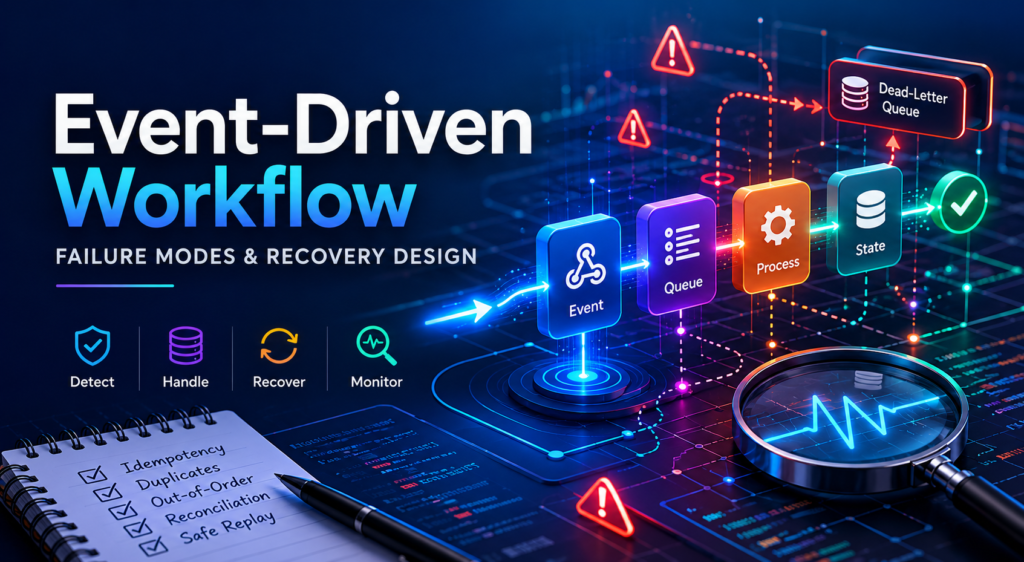
Event-Driven Workflow Failure Modes and Recovery Design
Last reviewed: 2026-05-10. This is a deep EskiLab implementation guide for event-driven workflow failure modes. It is written for teams that need operational reliability, not a surface-level definition.
Event-driven systems rarely fail like forms. They fail with duplicates, delays, missing events, ordering surprises, and replay side effects.
What this guide is designed to do
This guide helps teams debug and prevent failures in webhook, queue, and event-driven workflows where delivery is asynchronous and side effects matter. It focuses on the operating decisions behind the system: ownership, data contracts, failure modes, QA scenarios, monitoring, and the point where automation should stop and review should begin.
Who should use this
Developers, integration architects, automation teams, e-commerce operators, and saas builders using events or queues should use this as a production planning and QA reference. It is especially relevant when the workflow affects customers, analytics, public pages, revenue, product data, or long-running automation.
Executive summary
A reliable event-driven workflow failure modes system defines the operating contract, validates inputs before action, tests failure modes, monitors drift after launch, and documents ownership so the workflow can be maintained without guesswork.
Delivery assumptions must be explicit
Before designing handlers, write down the delivery model you expect. Is the provider at-most-once, at-least-once, best effort, or documented differently? Does it guarantee order? Can events arrive late? Can the same event be delivered more than once? If the answers are unknown, design as if duplicates and delays are possible.
Most event-driven damage comes from treating events as commands that must be executed exactly once. A safer model treats events as signals that may need idempotent processing, source reconciliation, and state verification.
Separate state changes from side effects
Updating internal state and sending an email are not the same risk. A replayed state update can often be made safe with idempotency. A replayed email or fulfillment request can create visible customer impact. Separate pure state updates from external side effects and make side effects require stronger guards.
Where possible, store the event first, validate it, update state idempotently, then trigger side effects through a separate controlled process.
Dead-letter queues need ownership
A dead-letter queue is not a trash can. It is an incident queue. Every dead-lettered event needs a failure reason, retry policy, owner, review schedule, and replay decision. If nobody reviews it, the system has only moved the failure out of sight.
Failure mode controls
| Failure mode | Risk | Control |
|---|---|---|
| Duplicate event | Duplicate action | Event ID store and idempotent consumer |
| Out-of-order event | Old state overwrites new state | Event timestamp and source reconciliation |
| Missing event | Downstream system never updates | Scheduled API reconciliation |
| Poison event | Queue keeps failing | Dead-letter queue with reason |
| Unsafe replay | Repeats customer-facing action | Replay dry-run and side-effect guard |
Replay decision table
| Event type | Replay allowed? | Condition |
|---|---|---|
| State sync | Usually yes | Idempotent and current-state checked |
| Customer email | Only with approval | Deduped and reviewed |
| Payment capture | Rarely direct | Use provider idempotency and reconciliation |
| Inventory update | Yes with care | Source of truth verified |
| Webhook verification failure | No | Request was not trusted |
Implementation workflow
- Define event identity and source of truth.
- Store every received event with status before processing.
- Make consumers idempotent using event IDs or business keys.
- Use timestamps and version fields to avoid stale updates.
- Route repeated failures to a dead-letter queue with reason codes.
- Create separate handling for side-effect actions.
- Build safe replay tooling with dry-run and approval options.
- Run periodic reconciliation against the source system.
Common mistakes that make this system shallow
- Assuming webhooks arrive once and in order.
- Sending emails directly inside the raw event handler.
- Retrying payment or fulfillment actions without idempotency.
- Ignoring dead-letter queues until users complain.
- Replaying all failed events without reviewing side effects.
- Not reconciling with the source of truth.
Pre-production QA checklist
- [ ] Event IDs are stored.
- [ ] Duplicate delivery is tested.
- [ ] Out-of-order events are tested.
- [ ] Dead-letter queue has an owner.
- [ ] Replay dry-run exists.
- [ ] Reconciliation job exists for critical state.
Monitoring signals after launch
Do not judge the system only by whether the first test worked. Use ongoing monitoring to detect drift, silent failure, and operational risk.
- event lag
- duplicate event count
- dead-letter volume
- replay success rate
- source reconciliation mismatch count
Incident review questions
- What exact input, event, URL, record, prompt, or action triggered the failure?
- Was the failure caused by source data, mapping, permissions, timing, platform behavior, or missing validation?
- Did the system fail safely, or did it create a downstream side effect?
- Was the issue visible in logs or only discovered by a user?
- What rule, test case, monitor, or approval step should be added so this failure is easier to catch next time?
Official documentation to check
Recommended operating standard
For event-driven workflow failure modes, the minimum operating standard is: define the contract, test the failure modes, monitor the output, document the owner, and keep a rollback or review path. Anything less may work in a demo but will be fragile in production.
FAQ
Why is event-driven workflow failure modes not just a one-time setup?
Because the surrounding systems change: APIs, tools, data, user behavior, plugins, prompts, feeds, and business rules. A one-time setup without monitoring becomes stale.
What is the first thing to test?
Test the failure mode that would create the most business damage: duplicate writes, wrong public pages, bad tracking, invalid feed data, unsafe AI action, or broken indexation.
Should this be automated completely?
Only low-risk, reversible steps should be fully automated. Anything that changes customer data, sends messages, publishes pages, affects payments, or modifies important SEO signals should have review, logging, or staged rollout.
How do I know the article's system is deep enough to publish?
It should include a real operating model: data fields or rules, failure modes, QA scenarios, monitoring signals, mistakes, and official documentation references.