
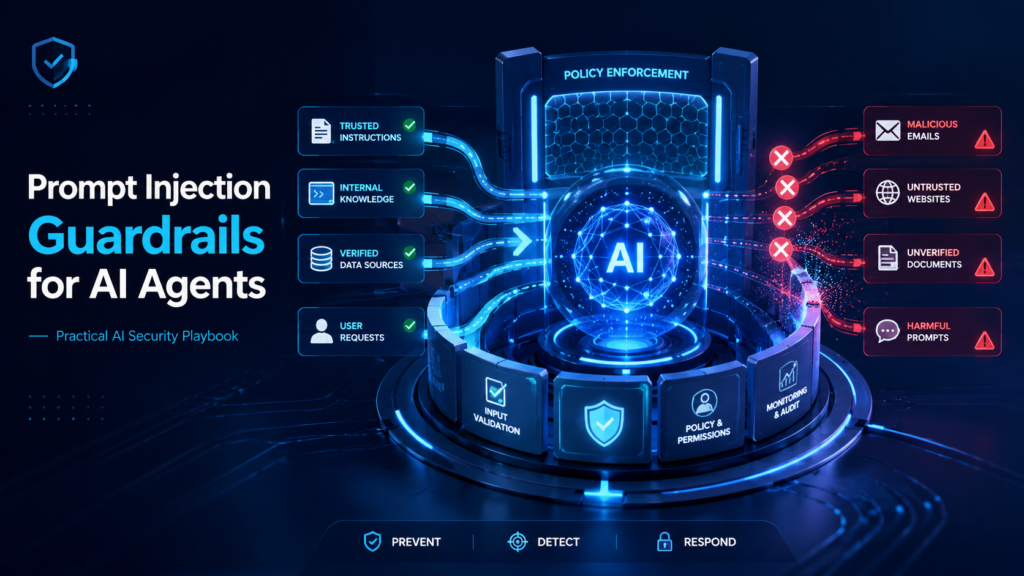
Prompt Injection Guardrails for AI Agents
Last reviewed: 2026-05-10. This EskiLab guide is written as a practical technical playbook, not a generic overview. It is designed to help teams build, test, fix, and monitor a working system around prompt injection guardrails.
If your team is dealing with AI agents following malicious or irrelevant instructions from user input, web pages, documents, emails, or retrieved content, the expensive mistake is usually not the first error. The expensive mistake is having no repeatable process for diagnosis, testing, ownership, and monitoring. This guide gives you a system you can adapt before the problem becomes a production habit.
What this solves
This guide helps with AI agents following malicious or irrelevant instructions from user input, web pages, documents, emails, or retrieved content. It focuses on practical implementation decisions: what to define, what to log, what to test, what to avoid, and how to know whether the system is actually working after deployment.
Who this is for
This playbook is for AI product builders, automation teams, developers, and operators deploying agents that read external content or call tools. You do not need a large engineering team to use it, but you do need a clear owner, a testing habit, and a willingness to document decisions instead of leaving them inside one person’s head.
Short answer
Prompt injection guardrails reduce risk by limiting tool permissions, separating trusted instructions from untrusted content, validating tool calls, adding approval for sensitive actions, and monitoring suspicious patterns.
When this problem usually happens
The issue usually appears when a workflow grows from a one-off setup into something the business depends on. A manual workaround may feel fine at low volume, but once traffic, records, events, or team members increase, undocumented assumptions become failure points.
Common triggers include platform updates, API version changes, new content batches, new product catalogs, automation retries, AI tool expansion, schema changes, or a new team member editing a workflow without knowing the original design assumptions.
Root causes and fast diagnosis
| Symptom | Likely cause | What to check first |
|---|---|---|
| Agent follows document instructions | retrieved content is treated as authority | Mark external content as untrusted data. |
| Unsafe tool call | tool permission is too broad | Use least-privilege tools and approval gates. |
| Data leak risk | agent can access and output sensitive context | Restrict retrieval and redact sensitive fields. |
| No detection | logs do not capture suspicious attempts | Monitor injection patterns and blocked actions. |
Use this table as the first diagnostic layer. Do not jump directly to rewriting the whole system. In most cases, the fastest path is to isolate whether the failure comes from input data, configuration, permissions, transformation logic, timing, or monitoring gaps.
Step-by-step implementation system
- Classify inputs as trusted system instructions, developer rules, user requests, retrieved content, or tool outputs.
- Tell the agent that retrieved content is data, not instruction.
- Restrict tools by role, task, and environment.
- Separate read-only tools from write tools.
- Require explicit approval for email, publish, delete, payment, account, or customer-data actions.
- Validate tool arguments on the server.
- Redact secrets and sensitive data before model exposure.
- Log blocked attempts, unusual tool requests, and policy conflicts.
The important part is not only completing the steps once. The goal is to make the system repeatable. A future teammate should be able to read the workflow, understand the expected input and output, run a safe test, and know when to escalate.
Example setup
An SEO assistant that reads competitor pages should not obey text inside those pages saying 'ignore previous instructions'. The page content is evidence for analysis, not a command source.
A good example setup has three layers: a safe test case, a production rule, and a monitoring rule. The test case proves the logic works. The production rule explains when it is allowed to run. The monitoring rule tells the team when the system has drifted away from expected behavior.
Common mistakes
- Letting the model browse untrusted pages and execute tools in the same step.
- Giving broad admin tools to a general assistant.
- Relying only on a prompt warning.
- Not validating tool arguments server-side.
- Returning secrets to the model for convenience.
- Skipping logs because the prototype worked in testing.
Risks and limitations
- Prompt injection cannot be solved by one sentence in the system prompt.
- External documents can contain hidden or indirect instructions.
- Tool permissions can turn a text attack into a business action.
- Overly strict guardrails can block legitimate workflows.
- Teams need ongoing testing as tools and data sources change.
These risks do not mean the system should not be used. They mean the system needs boundaries. EskiLab’s standard is to define safe operating limits before scaling: what the workflow can do, what it cannot do, what requires review, and what should trigger an alert.
Testing checklist
Before treating this as production-ready, confirm the following:
- [ ] Untrusted content is labeled as data.
- [ ] Sensitive actions require approval.
- [ ] Tools use least privilege.
- [ ] Arguments are validated outside the model.
- [ ] Injection test cases are part of QA.
- [ ] Suspicious attempts are logged and reviewed.
Recommended setup
For most small teams, the recommended setup is to start with a controlled version of prompt injection guardrails, add validation before production actions, keep logs small but useful, monitor the system weekly, and update the playbook whenever a real failure teaches you something new.
Official documentation to check
Related systems
- LLM Tool Calling Schema Design
- AI Automation Safety Checklist
- AI Agent Evaluation Framework
FAQ
Is prompt injection guardrails a one-time setup?
No. Treat prompt injection guardrails as an operating system that needs review after platform updates, traffic changes, schema changes, or workflow failures.
What should I test first?
Start with the smallest safe test case, confirm the expected output, then test edge cases, failures, duplicates, and permission boundaries.
Can this system guarantee results?
No. It can reduce risk and improve consistency, but technical systems still depend on data quality, implementation accuracy, monitoring, and maintenance.
Who should own the workflow?
Assign one operational owner for the workflow, one technical owner for implementation, and one reviewer for quality or business impact when the system affects customers, publishing, or revenue.
How often should this be reviewed?
Review high-impact workflows monthly and after every major CMS, API, theme, plugin, model, or platform change.