
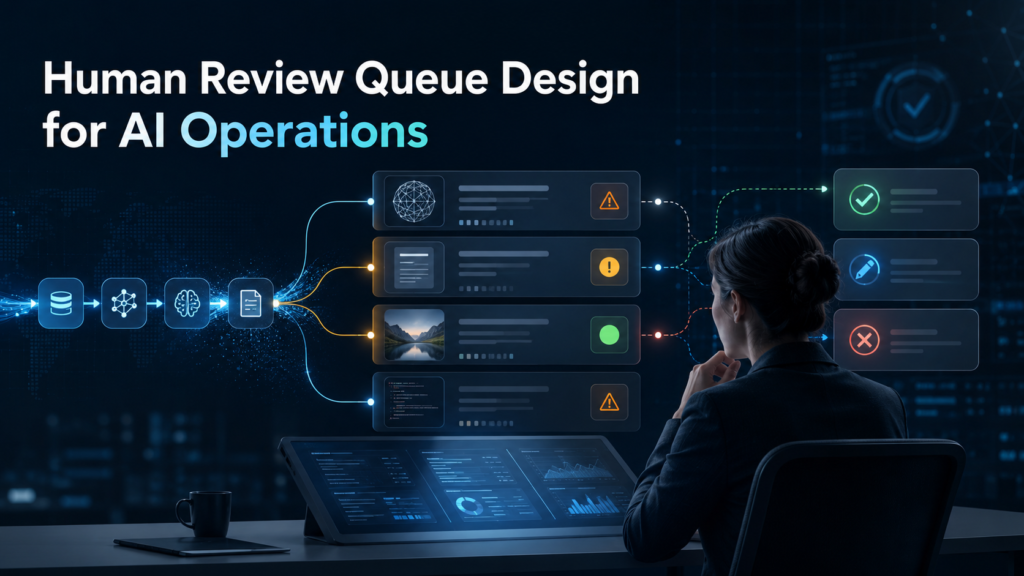
Human Review Queue Design for AI Operations
Last reviewed: 2026-05-10. This is a deep EskiLab implementation guide for human review queue for AI operations. It is written for teams that need operational reliability, not a surface-level definition.
Human-in-the-loop is not automatically safe. The queue design determines whether reviewers actually catch risk or just click approve.
What this guide is designed to do
This guide helps teams prevent AI workflows from becoming rubber-stamped or fully automated in places where review is still necessary. It focuses on the operating decisions behind the system: ownership, data contracts, failure modes, QA scenarios, monitoring, and the point where automation should stop and review should begin.
Who should use this
Ai operators, agencies, marketers, support teams, product managers, and developers using ai-generated recommendations or actions should use this as a production planning and QA reference. It is especially relevant when the workflow affects customers, analytics, public pages, revenue, product data, or long-running automation.
Executive summary
A reliable human review queue for AI operations system defines the operating contract, validates inputs before action, tests failure modes, monitors drift after launch, and documents ownership so the workflow can be maintained without guesswork.
Review queues need decision design
A review queue is not a dumping ground for AI outputs. It is a decision system. Each item should tell the reviewer what the AI produced, why it produced it, what sources or inputs were used, what the risk level is, what action is requested, and what choices the reviewer has.
If reviewers see only the final AI output, they cannot evaluate evidence. If they see too much raw context, they slow down or approve blindly. The design goal is enough context for a reliable decision.
Risk-based routing
Do not send every AI output through the same review path. Low-risk drafts can use sampling. Customer-facing messages, public publishing, account changes, financial data, legal-sensitive content, or destructive actions need stronger review. Risk labels should be rule-based where possible.
Useful risk factors include reversibility, customer impact, revenue impact, privacy exposure, topic sensitivity, confidence score, source quality, and whether the action is public or internal.
Feedback loop after review
The review queue should improve the system. Rejected outputs, edits, escalations, and reviewer comments should become categorized feedback. If the same error repeats, fix the prompt, schema, retrieval source, tool permission, or upstream data instead of expecting reviewers to catch it forever.
Review queue fields
| Field | Why it matters | Example |
|---|---|---|
| risk_level | Controls priority | high |
| source_evidence | Lets reviewer verify | policy URL, retrieved doc ID |
| proposed_action | Clarifies what approval does | publish title update |
| AI_confidence | Adds signal, not proof | 0.72 |
| reviewer_decision | Creates audit trail | approve with edits |
Routing rules
| Output type | Review level | Reason |
|---|---|---|
| Internal draft | Sampled QA | Low external impact |
| Customer email | Human approval | Customer-facing |
| Public article | Editorial review | Search and trust impact |
| Delete/update record | High-risk approval | Destructive or data-changing |
| Payment action | Escalated approval | Financial impact |
Implementation workflow
- Classify AI outputs by action type and risk.
- Define reviewer actions: approve, edit, reject, escalate, request more information.
- Show evidence and source context with each output.
- Log reviewer, decision, edit reason, and final action.
- Prioritize high-risk items first.
- Use sampling for low-risk items instead of blocking everything.
- Categorize repeated failure reasons.
- Feed review insights back into prompts, retrieval, schemas, and tool permissions.
Common mistakes that make this system shallow
- Putting every AI output into review forever.
- Showing reviewers no source evidence.
- Not logging why an output was rejected.
- Using one reviewer for all risk levels.
- Letting urgent queues hide high-risk items.
- Never improving the upstream system from review data.
Pre-production QA checklist
- [ ] Risk levels are defined.
- [ ] Reviewer actions are standardized.
- [ ] Source evidence is visible.
- [ ] Approval decisions are logged.
- [ ] Escalation path exists.
- [ ] Repeated errors are reviewed upstream.
Monitoring signals after launch
Do not judge the system only by whether the first test worked. Use ongoing monitoring to detect drift, silent failure, and operational risk.
- approval rate
- edit rate
- rejection reason count
- time in queue
- high-risk backlog
- post-approval incident count
Incident review questions
- What exact input, event, URL, record, prompt, or action triggered the failure?
- Was the failure caused by source data, mapping, permissions, timing, platform behavior, or missing validation?
- Did the system fail safely, or did it create a downstream side effect?
- Was the issue visible in logs or only discovered by a user?
- What rule, test case, monitor, or approval step should be added so this failure is easier to catch next time?
Official documentation to check
Recommended operating standard
For human review queue for AI operations, the minimum operating standard is: define the contract, test the failure modes, monitor the output, document the owner, and keep a rollback or review path. Anything less may work in a demo but will be fragile in production.
FAQ
Why is human review queue for AI operations not just a one-time setup?
Because the surrounding systems change: APIs, tools, data, user behavior, plugins, prompts, feeds, and business rules. A one-time setup without monitoring becomes stale.
What is the first thing to test?
Test the failure mode that would create the most business damage: duplicate writes, wrong public pages, bad tracking, invalid feed data, unsafe AI action, or broken indexation.
Should this be automated completely?
Only low-risk, reversible steps should be fully automated. Anything that changes customer data, sends messages, publishes pages, affects payments, or modifies important SEO signals should have review, logging, or staged rollout.
How do I know the article's system is deep enough to publish?
It should include a real operating model: data fields or rules, failure modes, QA scenarios, monitoring signals, mistakes, and official documentation references.