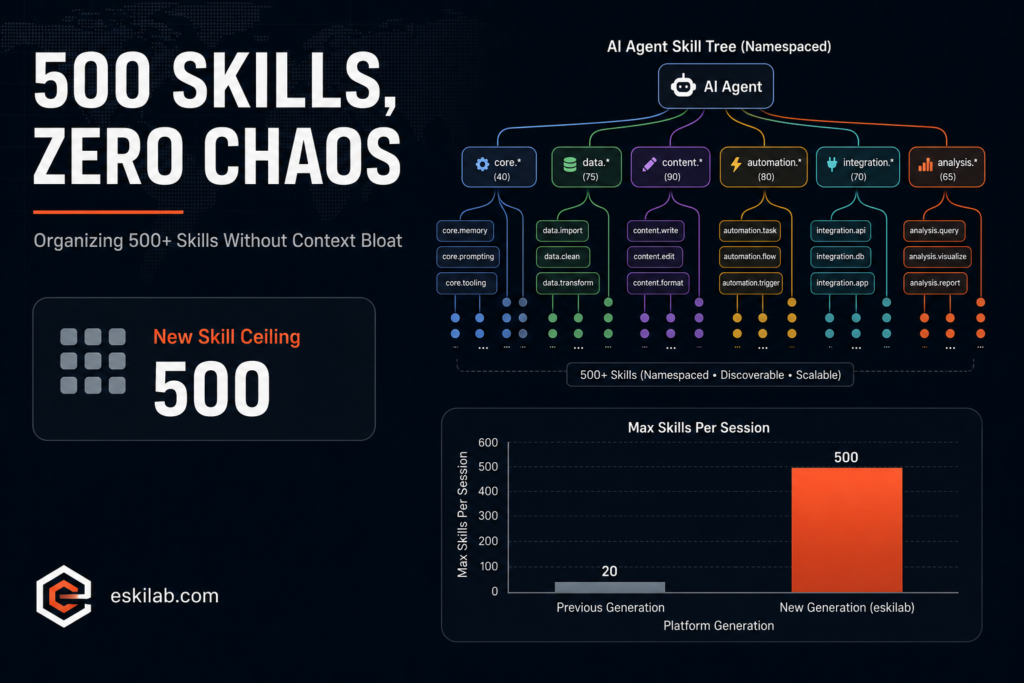
Raising the skill limit on managed agent platforms from 20 to 500 solves a real problem — a single session can now hold an entire team’s or product’s knowledge base instead of forcing you to pick a handful of skills and leave the rest out. It also creates a problem the 20-skill limit made impossible to have: an agent choosing between dozens of plausible-looking skills for a given task, matching the wrong one, or burning context loading definitions it never needed. A skill library sized for 20 and a skill library sized for 500 are different design problems, not the same problem at a bigger number.
Why More Skills Isn’t Just More of the Same
At 20 skills, an agent’s matching problem is close to trivial — descriptions can overlap somewhat and the agent still picks correctly most of the time because the candidate pool is small. At 500, ambiguous or overlapping descriptions become the dominant failure mode. Two skills both plausibly matching “send a message” or “look up a customer” is a minor issue at 20 and a routine, repeated source of wrong tool calls at 500, unless the library is deliberately structured to avoid it.
Design Principles for a Library This Size
| Principle | What It Looks Like in Practice |
|---|---|
| Namespace by domain, not by team | Prefix skill names by function (billing-refund-issue, billing-invoice-lookup) rather than by the team that authored them, since agents match on function, not org chart |
| One clear job per skill | A skill that tries to cover three related-but-distinct tasks is harder to match correctly than three narrow skills — split before you’re tempted to write a longer, hedging description |
| Descriptions written for disambiguation, not documentation | The description’s job is to be distinct from every other skill’s description in the library — write it by asking what makes this different from the closest similar skill, not by summarizing what it does in isolation |
| Deferred loading for rarely-used skills | Full schemas for long-tail skills shouldn’t load into every session by default — load on demand when a search step matches them, keeping baseline context small |
| Deprecation path, not silent removal | A skill that’s been superseded should redirect or fail with a clear pointer to its replacement for a transition window, not disappear and produce a confusing “tool not found” failure |
Monitoring a Library at Scale
- Track invocation frequency per skill. A library with 500 skills and 40 of them ever actually invoked is a discovery problem, not a coverage win — investigate whether the unused 460 have poor descriptions, genuine low demand, or are simply duplicated by something else in the library.
- Track mismatch rate — cases where an agent selected a skill that turned out to be wrong for the task, caught either by an explicit error or downstream review. Rising mismatch rate as the library grows is the clearest signal that description quality, not agent capability, is the bottleneck.
- Review near-duplicate skills quarterly. Libraries this size accumulate near-duplicates as different contributors solve overlapping problems independently — merge or clearly differentiate them before the agent has to guess which one you meant.
The Trade-off Worth Stating Plainly
A smaller, tightly-scoped skill library is easier to keep accurate and nearly impossible to get wrong on selection. A 500-skill library trades some of that selection reliability for coverage — an agent that can do far more, at the cost of needing real curation discipline to keep matching accuracy from degrading as the library grows. Treat the jump to a much higher skill ceiling as permission to cover more ground, not as a reason to skip the naming and disambiguation work that kept a small library reliable.