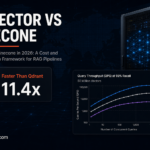
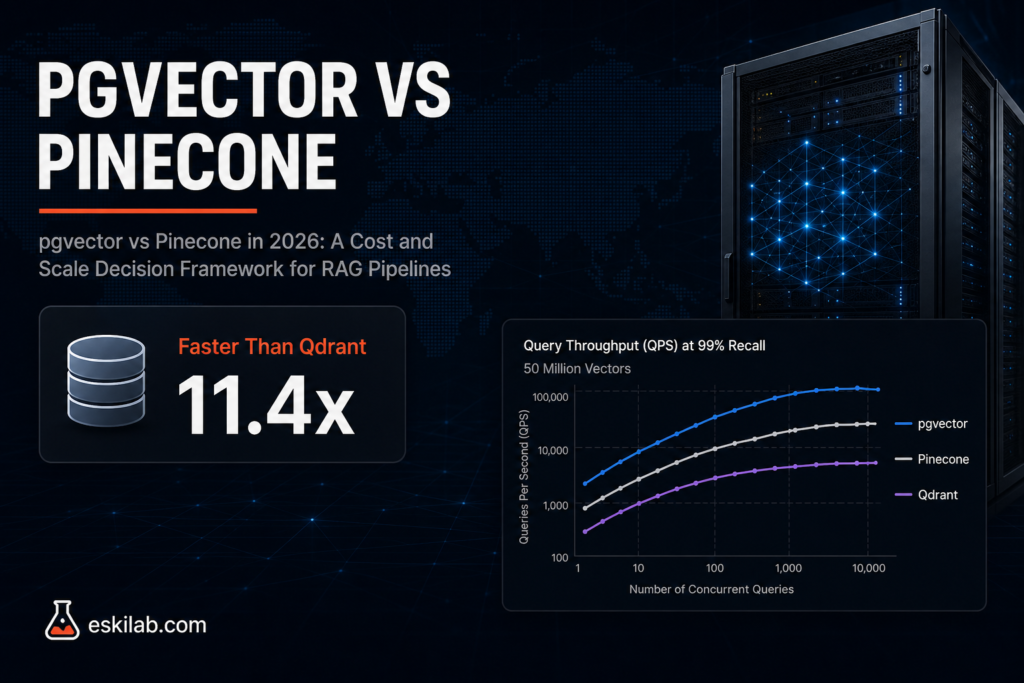
The “do you even need a dedicated vector database in 2026” question has a clearer answer than it did a year ago, and pgvectorscale is most of the reason why. Paired with pgvectorscale, PostgreSQL now delivers 471 QPS at 99% recall on 50 million vectors — reported as roughly 11.4x better than Qdrant and competitive with Pinecone on the same benchmark class. For a team already running Postgres, that closes a lot of the performance gap that used to be the main argument for a separate specialized store.
The Decision Isn’t Really “Which Is Faster”
At moderate scale, both options can serve a RAG pipeline well, so the deciding factors are usually operational, not raw performance:
| Factor | pgvector (+ pgvectorscale) | Pinecone |
|---|---|---|
| Best fit by scale | Strong up to and beyond 50M vectors with pgvectorscale; the clear default choice under 10M vectors even without it | Purpose-built for very large-scale, high-throughput agentic workloads with less tuning effort required |
| Operational overhead | You own index tuning, upgrades, and scaling — but it’s one less system to operate if you’re already on Postgres | Fully managed — less operational work, but you’re dependent on their roadmap and pricing decisions |
| Extra capabilities | Whatever your Postgres setup already gives you (transactions, joins, existing backup tooling) applied directly to vector data | Hosted inference and reranking, an Assistant layer for production chat/agent apps, dedicated read nodes for read-heavy workloads, native full-text search |
| Pricing entry point | Cost is your existing Postgres infrastructure plus the extension — no separate vector-specific bill | New Builder plan at $20/month flat (introduced May 2026) as an entry tier between Starter and Standard |
| Vendor trajectory | Open-source extension, no single-vendor lock-in risk | Reportedly exploring a sale while managing customer churn — worth factoring into a long-term architecture bet |
A Practical Decision Framework
- Default to pgvector if you’re already running Postgres and under roughly 10M vectors. This is close to a settled recommendation at this point — adding a second database for this scale is usually unnecessary operational surface area.
- Add pgvectorscale before considering a switch to a dedicated vector store once you approach or exceed that range — the benchmark evidence suggests it closes most of the performance gap that used to force a migration.
- Choose Pinecone when you need the platform, not just the index — hosted embedding/reranking, an Assistant layer for a production agent app, or dedicated read-node scaling for a read-heavy workload are real capabilities that a bare vector index (in Postgres or otherwise) doesn’t replicate on its own.
- Weigh vendor stability explicitly if you’re making a multi-year architecture commitment — reported acquisition exploration and churn issues are a legitimate input to a build-vs-buy decision, not just market noise.
- Don’t migrate off pgvector purely for a marginal performance number if your actual bottleneck is chunking quality, embedding model choice, or retrieval evaluation gaps upstream of the database — a faster vector store doesn’t fix a retrieval quality problem caused by something earlier in the pipeline.
What to Test Before Committing
Benchmark numbers from any vendor or third party are a starting point, not a substitute for testing against your own document set, embedding dimensions, and query patterns — recall and latency at scale depend heavily on your specific data characteristics, and the gap between a published benchmark and your production numbers can be significant in either direction.