Disclosure: EskiLab is reader-supported. Some links below may be affiliate links. We only list tools we consider credible for the use case, and an affiliate relationship does not change a tool’s placement or assessment. Pricing and features change often—verify current details on the vendor’s site before buying.
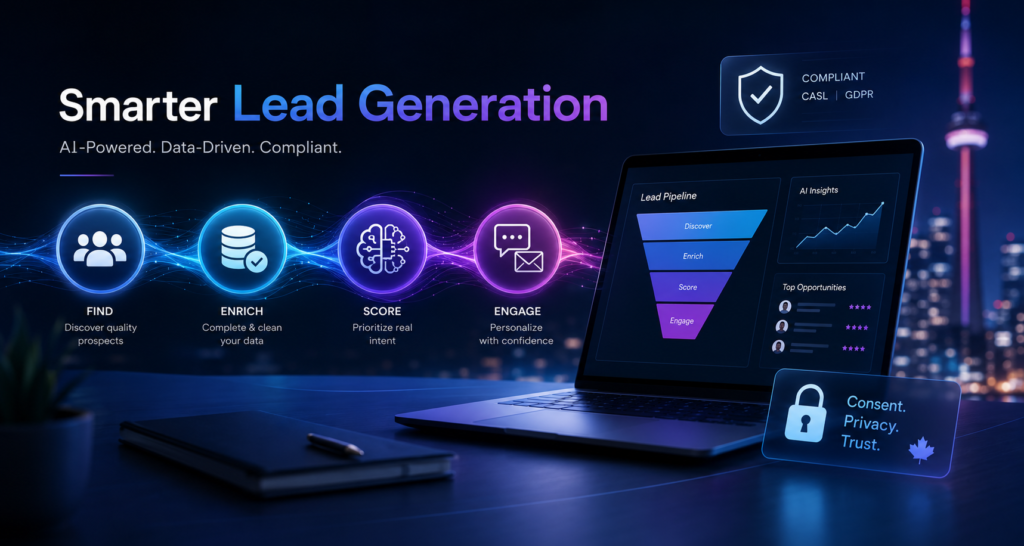
“AI lead generation” covers four different jobs: finding prospects, enriching their data, scoring intent, and engaging them. Most tools do one or two well and oversell the rest. This guide breaks lead gen into those stages, compares the tool types for each, and—because EskiLab operates from Canada and many readers email prospects—keeps GDPR and CASL compliance front and center, since automated outreach is where teams get into legal trouble.
Short answer: There is no single best AI lead-gen tool. For finding and enriching leads, data platforms like Apollo and Clay lead; for scoring and routing, your CRM’s AI features help; for engagement, AI chat and email tools assist. The constraint that decides your stack is compliance: under CASL and GDPR, how you contact leads matters more than how you find them.
Who this is for
- Founders and small teams building a repeatable lead pipeline
- Marketers adding AI to prospecting, enrichment, or scoring
- Sales ops choosing tools that fit an existing CRM
- Anyone doing cold outreach who must comply with CASL/GDPR
How we compared these tools
We split lead gen into stages and judged tools on:
- Data accuracy and freshness for finding and enriching leads
- Quality of AI scoring/intent signals, not just volume
- Integration with your CRM and existing workflow
- Compliance support for consent, opt-out, and record-keeping
- Cost per lead/credit and how it scales
Quick comparison
| Stage | Tool type | Strength | Compliance watch |
|---|---|---|---|
| Find leads | Apollo, data platforms | Large contact databases | Lawful basis to contact |
| Enrich data | Clay, enrichment APIs | Fill gaps, dedupe | Data source legality |
| Score / route | CRM AI features | Prioritize real intent | Avoid opaque profiling |
| Engage | AI chat & email tools | Faster outreach | CASL/GDPR consent & opt-out |
Treat the table as a starting filter, not a verdict. The right pick depends on your stack, budget, and how much you want to maintain.
The stages, and the tools that fit each
Finding leads (Apollo and data platforms)
Contact databases with AI search help you build targeted prospect lists fast. The value is data accuracy and filtering. The risk is assuming that because you can find an email, you may legally cold-email it—especially into the EU or Canada, where lawful basis and consent rules apply.
Best when: you need to build targeted B2B prospect lists quickly. Watch out for: finding a contact is not consent to email it; check your lawful basis.
Enriching data (Clay and enrichment APIs)
Enrichment tools fill gaps in your records—role, company, signals—and AI helps dedupe and structure messy data. This makes scoring and personalization far better. Confirm the legality of the data sources and keep records of where data came from.
Best when: you have partial lead data and want it complete and clean. Watch out for: data provenance matters for compliance; keep source records.
Scoring and routing (CRM AI features)
Your CRM’s AI scoring prioritizes leads by likely intent so reps focus on the real ones. Used well, it improves efficiency. Used badly, it becomes opaque profiling you cannot explain—which is a problem under GDPR. Keep scoring inputs explainable.
Best when: you have enough lead volume that prioritization matters. Watch out for: keep scoring logic explainable; avoid black-box profiling of individuals.
Engaging leads (AI chat and email tools)
AI chat and email tools speed up qualification and follow-up. This is the highest-compliance-risk stage: under CASL, commercial electronic messages generally require consent and a working unsubscribe, and GDPR adds its own rules. Automate the drafting, not the disregard for consent.
Best when: you have consented contacts and want faster, personalized follow-up. Watch out for: CASL/GDPR consent and opt-out are mandatory; automation does not exempt you.
How to choose: a simple decision framework
- Map your funnel stages and find the one weakest link—fix that first.
- Confirm your lawful basis to contact before scaling any outreach (CASL/GDPR).
- Choose tools that integrate with your CRM so data stays clean and centralized.
- Keep AI scoring explainable; avoid opaque profiling of individuals.
- Automate drafting and routing, but keep consent and opt-out handling airtight.
Common mistakes
- Treating “we found the email” as permission to cold-email it
- Skipping consent and unsubscribe handling on automated outreach (CASL/GDPR breach)
- Buying tools for every stage when only one stage is weak
- Trusting AI lead scores without checking they reflect real intent
- Letting enrichment introduce data you cannot trace or justify
Risks and limitations
- Non-compliant outreach under CASL or GDPR carries real penalties
- Inaccurate data wastes spend and damages sender reputation
- Opaque AI profiling can breach data-protection rules
- Per-credit pricing scales fast with large lists
- Over-automating engagement can harm brand and deliverability
Selection checklist
- [ ] I identified the weakest funnel stage to fix first
- [ ] I confirmed lawful basis to contact under CASL/GDPR
- [ ] Tools integrate with my CRM
- [ ] AI scoring inputs are explainable
- [ ] Consent and opt-out handling are airtight
- [ ] Cost per lead/credit at scale is modeled
Recommended setup
Start by fixing the single weakest stage of your funnel rather than buying a tool for every step. Use data platforms (Apollo, Clay) for finding and enriching, your CRM’s AI for explainable scoring, and AI chat/email for faster engagement—but treat compliance as the gate, not an afterthought. Operating from Canada, confirm your lawful basis under CASL and GDPR before any automated outreach, keep consent and opt-out airtight, and keep scoring logic explainable. Automate the drafting, never the consent.
Related guides
- Best AI Chatbots for Customer Support in 2026
- Best AI Tools for Workflow Automation in 2026
- Best AI Tools for E-commerce in 2026
FAQ
Is AI lead generation legal under CASL and GDPR?
The tools are legal; how you use them is what matters. Under CASL, commercial electronic messages generally require consent and a working unsubscribe, and GDPR requires a lawful basis and data-subject rights. Finding a contact does not grant permission to email it—confirm your basis first.
Which stage of lead gen benefits most from AI?
Enrichment and scoring usually give the cleanest wins: completing messy data and prioritizing likely intent. Engagement benefits too, but it carries the highest compliance risk, so automate drafting, not consent handling.
Do I need a tool for every stage?
No. Identify the weakest stage in your funnel and fix that first. Buying tools for every step usually creates overlap and cost without proportional results.
Can I trust AI lead scores?
Use them as a prioritization aid, not gospel. Check that scores reflect real intent signals, keep the inputs explainable for GDPR, and avoid opaque profiling of individuals.