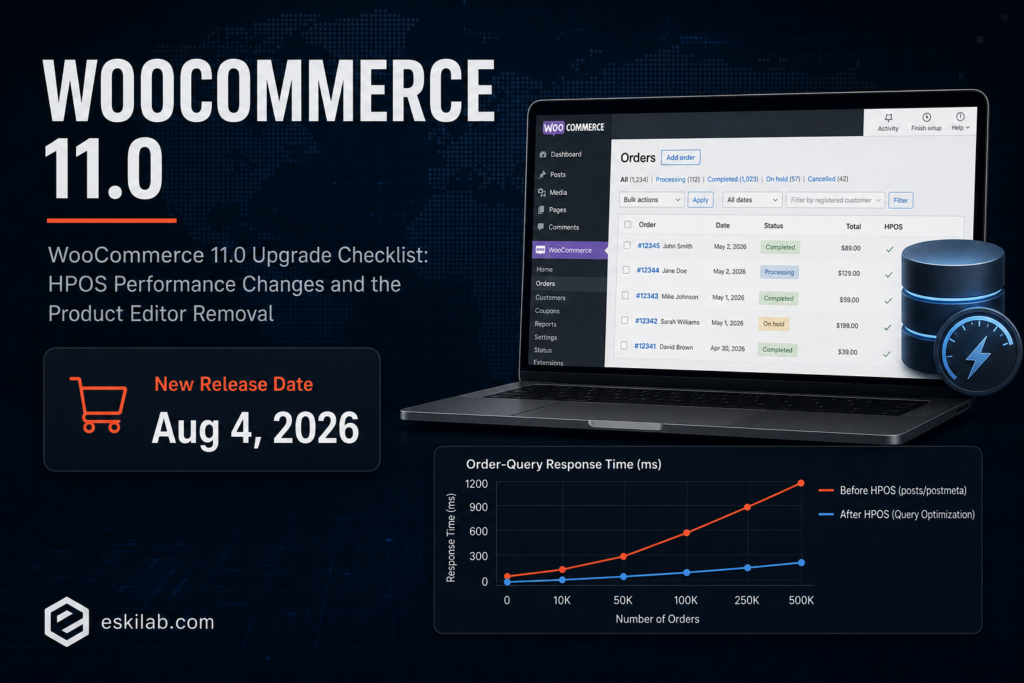
WooCommerce 11.0 slipped from its original July 28, 2026 date to August 4, after the team caught a fatal error during RC1 testing tied to one of the new performance features. That delay is itself useful information: this release touches enough store-critical plumbing — HPOS query optimization, product object caching turned on by default for new stores, the removal of the product-editor package from core — that treating it as a routine point upgrade is the wrong posture for any store above a few hundred SKUs.
What’s Changing Under the Hood
| Change | What It Affects | Who Should Care Most |
|---|---|---|
| HPOS Orders-screen query optimization | How order list queries execute against High-Performance Order Storage | Stores with large historical order volumes and custom order-list plugins or reports |
| Store API request de-duplication | Reduces redundant API calls during checkout and cart operations | Headless or custom-frontend stores calling the Store API directly |
| Product object caching on by default (new stores) | Caches product data objects to reduce database load | Any store relying on real-time product data mutations from external systems — cache invalidation timing matters here |
| @woocommerce/product-editor package removed from core | The editing UI for products changes; product data itself is unaffected | Sites or extensions with custom code hooking into the old product-editor routes or feature flag |
| New Settings UI (React shell) | Opted-in settings pages render through React while the underlying settings array and save flow stay intact | Extension developers with custom settings pages that assume the old rendering path |
A Pre-Upgrade Checklist
- Audit for direct references to the removed product-editor package — search custom code and third-party extensions for the feature flag or editor-specific routes named in the 11.0 changelog. Product data is unaffected, but code that assumed the old editing UI exists will break.
- Stage the upgrade on a full copy of production data, not a small test catalog — HPOS query behavior and caching effects mainly show up at realistic order and product volume, not on ten test SKUs.
- Test Store API-dependent integrations specifically if you run a headless frontend or a custom app calling the Store API — request de-duplication changes call patterns, and an integration that depended on the old repeated-request behavior for polling needs to be re-tested, not assumed compatible.
- Check product data freshness after enabling object caching — if anything updates product data outside the normal WooCommerce save flow (an external inventory sync, a custom import script), confirm the cache invalidates correctly rather than serving stale prices or stock levels.
- Hold the upgrade past the official release date if your store depends heavily on any of the five changes above — 11.0 was already delayed once for a fatal error caught in RC testing, which is a reasonable signal to wait for a 11.0.1 patch release before upgrading a high-revenue production store.
Where the Real Risk Sits
The product-editor package removal is the change most likely to break something silently rather than loudly — a broken editing UI reference typically throws a visible admin error, but a custom extension quietly falling back to a default behavior it wasn’t designed for can pass casual testing and only surface with a specific product type or edge case weeks later. Grep your active plugins and any custom code for the package name and feature flag before upgrading, not after something looks slightly off in the product catalog.