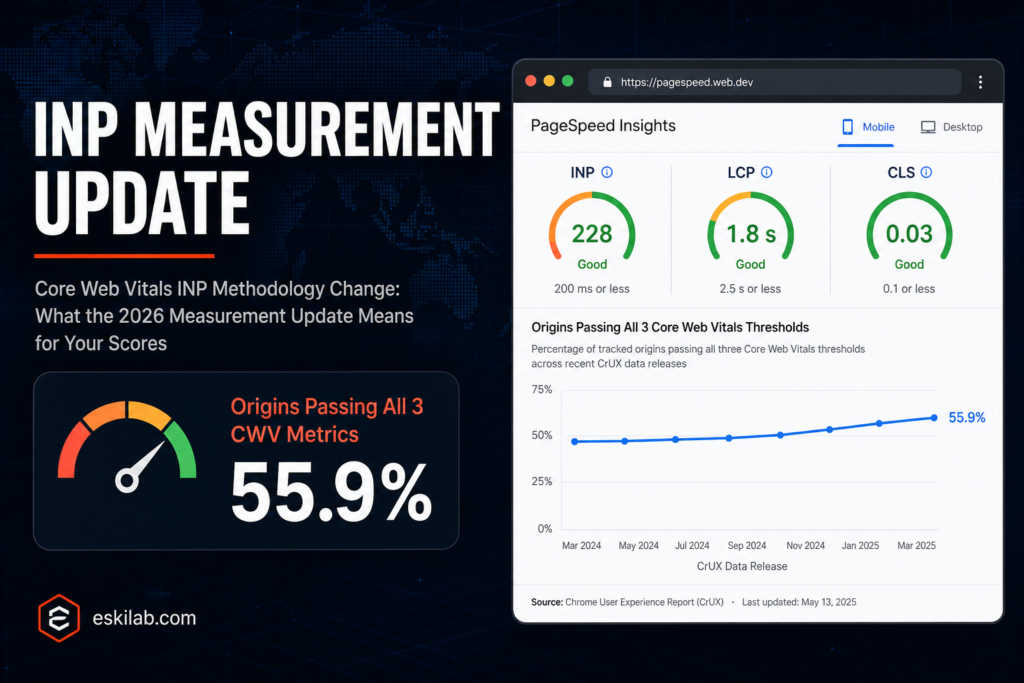
The 2026 Core Web Vitals update didn’t change the pass/fail thresholds — LCP is still 2.5 seconds, INP is still 200 milliseconds, CLS is still 0.1. What changed is the measurement methodology underneath INP, and that’s the part teams are missing when they check a dashboard, see the same threshold, and assume nothing to act on. The update tightened how sustained interaction latency gets captured, expanded soft-navigation support in CrUX for single-page apps, and made TTFB a more visible diagnostic in PageSpeed Insights without turning it into a ranking signal itself.
Why a Score Can Drop With No Threshold Change
The old INP measurement leaned more heavily on isolated slow interactions. The refined methodology weights sustained latency — a page that stays sluggish through a longer interaction sequence, not just a single laggy click — more heavily than before. Practically, this means pages with heavy filters, chat widgets, personalization scripts, or sticky headers that were previously scoring “Good” on the strength of a few fast individual interactions can now show worse INP, because the metric is capturing the frustrated-shopper experience of a page that stays slow across a whole interaction, not just its fastest moment.
Where the New Measurement Hits Hardest
| Page Pattern | Why It’s More Exposed Now |
|---|---|
| E-commerce filter and facet UI | Sustained interaction sequences (select filter, wait, select another) are exactly what the refined weighting captures more accurately |
| Chat widgets and support overlays | Often loaded with third-party scripts that degrade responsiveness through a session rather than on the first click |
| SPA/soft-navigation pages | Expanded CrUX support for soft navigations means client-side route changes are now measured more completely instead of being undercounted |
| Sticky headers with scroll-linked JS | Continuous scroll-interaction handling is a sustained-latency pattern the update is specifically designed to surface |
A Practical Response, Not a Panic
- Re-baseline before diagnosing. Pull fresh CrUX field data (the May 2026 release, published June 9, 2026, showed only 55.9% of tracked origins passing all three metrics) and compare your current numbers against a pre-update baseline rather than assuming any drop is a regression you caused.
- Profile sustained interaction sequences specifically in lab tools — a single click test won’t reproduce what the new methodology measures. Test a realistic sequence: open a filter, apply it, open another, scroll, interact with a result.
- Audit third-party scripts on interaction-heavy templates — chat widgets and personalization tags are common, unmonitored contributors to sustained latency that a team focused on their own code easily misses.
- Check soft-navigation handling on any SPA-style section of the site — if CrUX is now capturing these page transitions more completely, a client-side route change that felt “invisible” to old field data may now show up as a real interaction cost.
- Use the more prominent TTFB diagnostic in PageSpeed Insights as a lead indicator, not a ranking factor to chase directly — it’s diagnostic information pointing at server or CDN response time, which indirectly affects how much budget is left for everything INP measures downstream.
What Hasn’t Changed
The thresholds themselves are stable, and this isn’t a new ranking signal — it’s a measurement refinement to an existing one. Don’t rebuild a Core Web Vitals strategy from scratch over this; re-test the specific interaction patterns above, fix what the refined measurement is now surfacing accurately, and treat a post-update score drop as new visibility into a real problem rather than the update creating one.