Experiment 1
The Unlabeled Order: describe a reaction with no name
The Unlabeled Order is the first job of Night Shift. Only one of four bottles fits the order, and none of them says what it does. Finding the right bottle means both players have to talk their half of the information together. This page does not give the solution; it tells you what you will face.
What does this experiment ask of you?
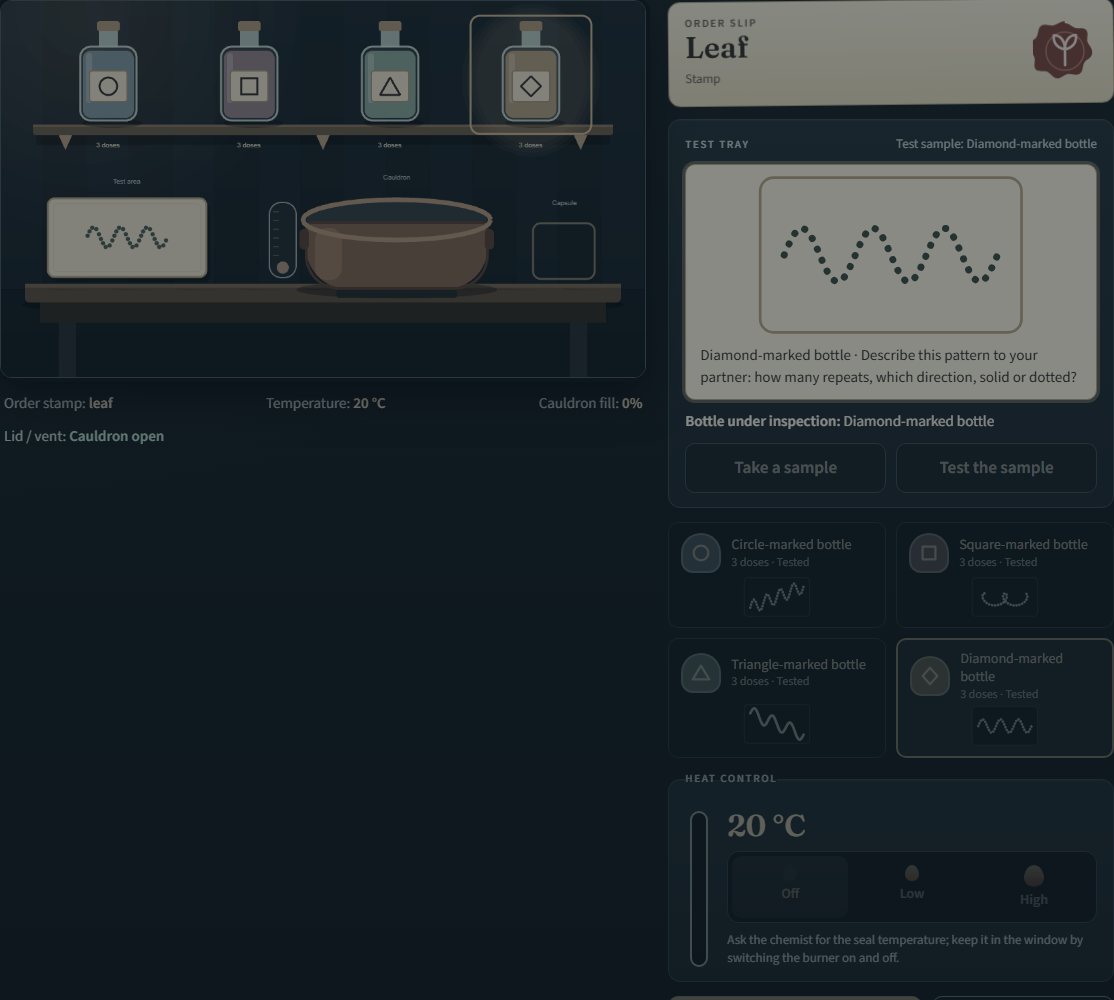
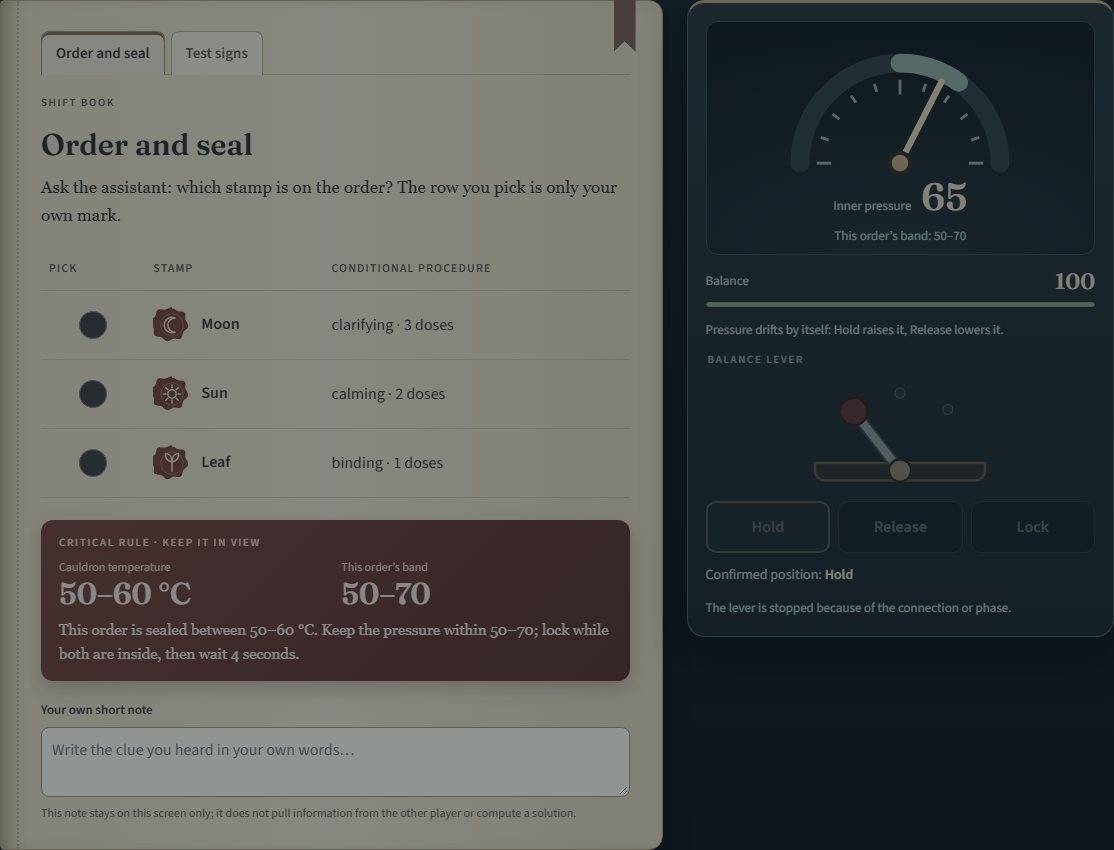
The assistant has an order slip, four bottles, a test tray and a burner. The chemist has the rule book, a pressure gauge and a three-position lever. The order asks for the right number of drops from the bottle with the behavior that matches the stamp, sealed at the right temperature.
The information is split on purpose. The assistant sees the stamp and the test results; the chemist reads which behavior the stamp calls for and which reaction each behavior produces. Only the chemist knows the seal temperature, and only the assistant can switch the burner on and off.
Why isn’t it easy?
A test result is a drawing, not a word: waves, zigzags, loops or small bursts, with different repeat counts, directions, and solid or dotted lines. Next to the real drawings, the chemist’s book has look-alikes that differ by a single detail. “Something wavy” is not enough; you have to say how many repeats there are and whether it goes up or down.
The order clock starts with the first test or the first drop. From then on the pressure drifts by itself, and the chemist has to keep it inside the band in the book using the lever. At the same time the assistant keeps the cauldron in the chemist’s temperature window by switching a burner with no thermostat on and off. The conversation goes on while both of you have your hands full.
Spoiler-free communication tips
These suggestions do not name the right bottle; they only make communication easier.
- Always describe the drawing in the same order: shape, repeat count, direction, line type.
- When the chemist is unsure, ask about the difference between two drawings: “Three or four?”
- Saying the temperature window once is not enough; the assistant reads the numbers aloud while approaching it.
- Locking only works while pressure and temperature are both inside. Remember to wait a few seconds after locking.
If something goes wrong
A wrong drop or runaway temperature makes the cauldron foam over. The alarm sounds and a three-mark valve order appears in the chemist’s book. The chemist reads the order; the assistant turns off the burner and enters it. Each attempt has one recovery, and the recovered cauldron’s trace can carry over to the next job in the shift.
The next job
When The Unlabeled Order is delivered, a raw capsule comes out of it, and that capsule is used in the second experiment, The Blind Manometer. The experiment is free and needs no account; when you open the same shift again, the drawings, windows and bands change.
One friend, two screens
Close the notebook. Open the shift.
The first three experiments are free. No account needed to start.